
“Aviation science with Crete at its core”
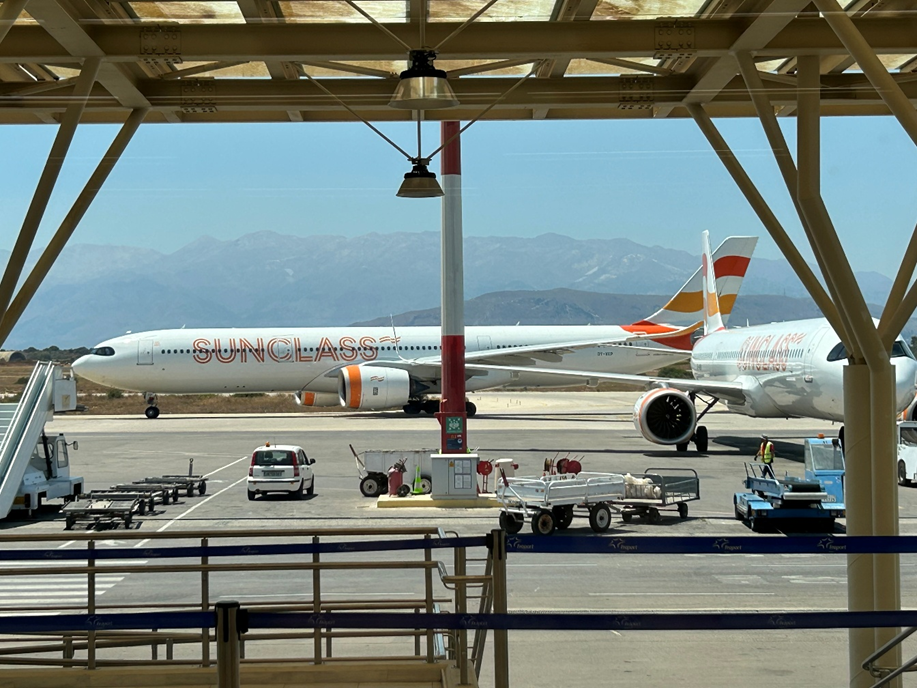
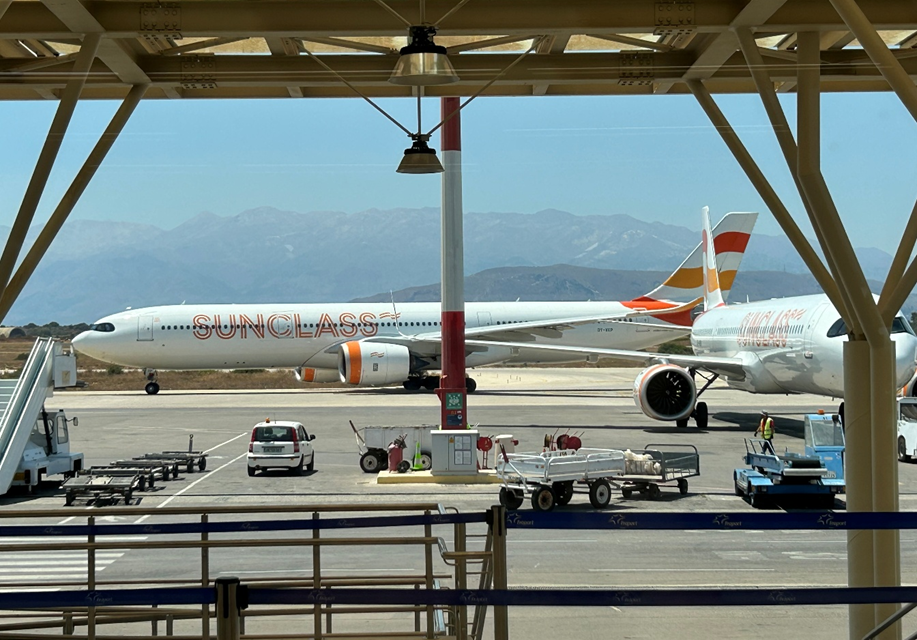
© Photo by Dimitris Zopounidis | Crete Aviation Observatory (CAO) 2025
The Empirical Research and Aviation Data Analysis project of the Crete Aviation Observatory (CAO) is conducted at Chania International Airport “Daskalogiannis”. The CAO collects and analyzes aviation-related data through passenger questionnaires distributed at the airport’s departure gates. The collected data are utilized to develop indicators and analytical insights regarding airlines, flight activity, aircraft operations, and the broader aviation industry.
The annual study is a scientific initiative led by Dimitris Zopounidis, PhD Candidate and Researcher at the Data Science Laboratory (DS Lab) of the School of Production Engineering and Management at the Technical University of Crete, founder of aviationlife.gr and the Crete Aviation Observatory.
aviationlife.gr is a specialized platform focused on civil aviation and the global aviation industry.
The Crete Aviation Observatory focuses on monitoring flight activity and airline operations at Chania International Airport, providing annual analyses and research outputs to organizations, institutions, and industry stakeholders.
The collaboration with the Tourism Observatory of Western Crete of the Mediterranean Agronomic Institute of Chania (MAICh), Fraport Greece, and the airport personnel of Chania Airport is essential for the successful implementation of the research.
Leading Airlines and Connectivity at Chania Airport
The top airline operators at Chania Airport during the summer period of 2025 are as follows:
- Ryanair Group – 23.9%
- SAS Scandinavian Airlines – 9.6%
- easyJet – 9.1%
- TUI – 6.7%
- Condor – 6.3%
- Jet Time – 6.0%
- AEGEAN Group – 4.5%
- Transavia – 3.8%
- Finnair – 3.6%
- Jet2.com / Wizz Air – 3.4%
- Sunclass Airlines – 3.2%
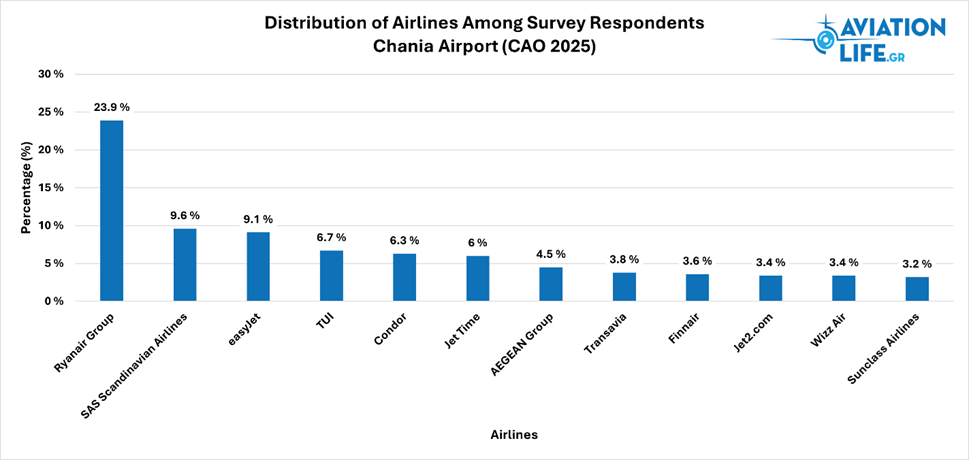
Chart: Crete Aviation Observatory (CAO, 2025)
Distribution and Categorization of Airlines at Chania Airport (CAO 2025)
The ranking generated from the Crete Aviation Observatory (CAO) data accurately reflects market reality, as it aligns by more than 90% with the official top operator rankings provided by the airport management company, Fraport Greece, during the examined period.
According to the findings, the leading airlines of 2025 consist of the following airline business models:
- 4 Low-Cost Carriers (LCCs): Ryanair Group, easyJet, Transavia, Wizz Air
- 3 Full-Service Carriers (FSCs): SAS Scandinavian Airlines, AEGEAN Group, Finnair
- 3 Leisure / Charter Airlines: TUI, Condor, Sunclass Airlines, Jet Time
- 1 Hybrid Airline (Leisure–Low Cost): Jet2.com
The 2025 market structure confirms the continuation of the trends observed over the previous three years, characterized by the dominance of low-cost carriers alongside the stable presence of traditional and leisure airlines.
The Ryanair Group (Ryanair DAC, Lauda Europe, Ryanair UK) remains the dominant airline operator, while easyJet and Wizz Air continue strengthening their market positions, highlighting the strategic importance of low-cost aviation in Western Crete.
Within the Full-Service Carrier segment, SAS Scandinavian Airlines and the AEGEAN Group (AEGEAN, Olympic Air) continue serving as major connectivity links between Crete, Scandinavia, and Athens, while Finnair records an enhanced market presence.
TUI, Condor, Sunclass Airlines, and Jet Time maintain their positions among the leading tour operator and charter carriers, confirming the strong relationship between Chania Airport and leisure tourism demand.
Jet2.com operates through a hybrid model that combines low-cost and leisure-oriented characteristics, adapting flexibly to diversified passenger demand.
Overall, the 2025 market structure highlights a mature and diversified aviation landscape, where the coexistence of multiple airline business models enhances both competitiveness and the international connectivity of Chania Airport with European markets.
Comparative Evolution of Airlines at Chania Airport (2022–2025)
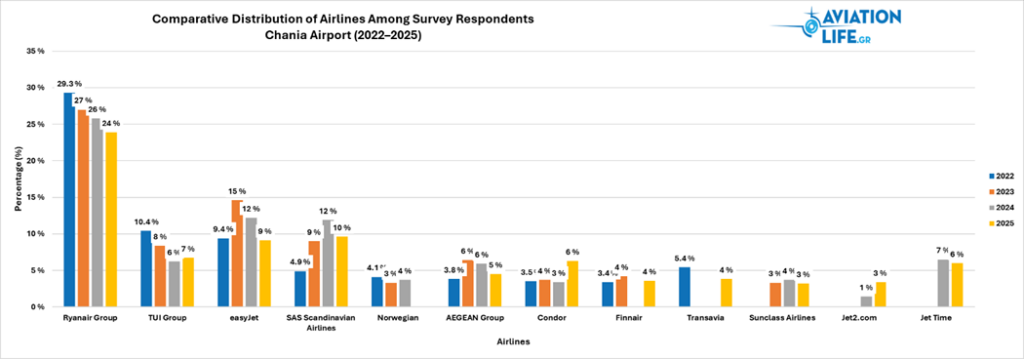
Chart: Crete Aviation Observatory (CAO, 2025)
The above chart, developed by the Crete Aviation Observatory (CAO), is based on data collected over recent years and presents a comparative analysis of passenger distribution by airline at Chania Airport for the years 2022, 2023, 2024, and 2025.
This analysis constitutes an important tool for understanding the evolution of passenger traffic and the structural trends shaping the aviation market of Western Crete.
Key Findings
- Ryanair Group: Despite a gradual decline in market share from 29.3% in 2022 to 23.9% in 2025, Ryanair remains the dominant airline operator at Chania Airport, confirming its strategic role in the region.
- TUI Group: Records a continuous decline from 10.4% in 2022 to 6.7% in 2025, potentially reflecting capacity reallocation and destination diversification strategies among tour operators.
- easyJet: Maintains a stable and strong presence, fluctuating between approximately 9–12%, confirming sustained demand for its Western European routes.
- SAS Scandinavian Airlines: Demonstrates significant growth from 4.9% in 2022 to 9.6% in 2025, highlighting the strong dynamics of the Scandinavian markets and the expansion of direct connectivity.
- AEGEAN Group: Shows moderate fluctuations (3.8% in 2022 to 4.5% in 2025), remaining the primary Greek carrier at the airport and the main connectivity link with Athens.
- Jet Time: Strengthens its presence, reaching 6.0% in 2025, confirming the effectiveness of its strategic cooperation with Scandinavian tour operators.
- Condor and Sunclass Airlines: Maintain relatively stable performance (approximately 3–6%), demonstrating resilience and sustained demand from Central and Northern European markets.
- Finnair and Transavia: Continue strengthening their positions, contributing to the broader geographical diversification of the airport’s network.
- Jet2.com: Shows gradual growth, reaching 3.4% in 2025, validating the effectiveness of its hybrid operating model.
Strategic Observations
The Ryanair Group continues to lead the market, although with a more balanced market share, as airlines such as SAS, easyJet, and Jet Time progressively strengthen their positions.
AEGEAN remains a stable pillar of domestic connectivity, while the continued presence of TUI, Condor, and Sunclass Airlines underlines the strategic importance of organized tourism for the region.
The analysis illustrates the evolving structure of Chania Airport’s passenger market, presenting a more diversified and competitive aviation ecosystem. The 2022–2025 period is characterized by market share rebalancing, increased diversification, and steady growth directly linked to the international tourism dynamics of Crete.
Leveraging Aviation Data for Strategic Decision-Making
The 2025 Research of the Crete Aviation Observatory, curated by Dimitris Zopounidis, provides a comprehensive and data-driven overview of the aviation ecosystem at Chania International Airport.
The study includes in-depth analyses regarding passenger behavior, airline selection patterns, travel demand characteristics, and critical aviation indicators that can support tourism stakeholders, airlines, institutional organizations, and decision-makers.
The research delivers actionable insights and measurable data capable of supporting strategic planning, development policies, and business decision-making within both the aviation and tourism sectors.
For access to the full report, detailed databases, and additional specialized information, interested parties may contact: dzopounidis@tuc.gr


