
A historical, financial and strategic analysis of Switzerland’s former flag carrier, 1931–2002
An Aviationlife.gr Research Feature by Dimitris Zopounidis | November 2026
Historical aviation | Airline economics | Corporate strategy | Financial risk | Governance
Abstract
For seven decades, Swissair represented an unusually powerful convergence of national identity, technical expertise, international connectivity and corporate prestige. The airline transformed Switzerland’s geographical position into a competitive aviation asset and established a reputation for service quality, operational discipline and institutional reliability.
Yet Swissair’s final chapter exposed a fundamental weakness in the economics of airline expansion: a respected brand and an extensive network cannot compensate indefinitely for inadequate capital allocation, weak financial controls and growing liquidity exposure.
Using historical operating statistics, SAirGroup financial disclosures, Swiss federal documentation, airline industry records and subsequent investigations, this study examines the development of Swissair’s business model, its international expansion strategy, its financial deterioration and its eventual collapse.
The evidence suggests that Swissair’s failure cannot be adequately explained by the external shock of September 11, 2001. Its vulnerability had accumulated before that event, particularly through an ambitious investment strategy that increased exposure to financially troubled European airlines while reducing the group’s capacity to absorb adverse developments.
The central conclusion is that Swissair’s brand remained an extraordinary commercial asset even as its underlying financial architecture became increasingly fragile. Its legacy therefore extends beyond aviation history: it offers enduring lessons in strategic management, corporate governance, capital allocation and the relationship between growth and economic resilience.
1. The creation of a national aviation institution
Swissair was established on March 26, 1931, through the merger of two Swiss aviation pioneers, Balair and Ad Astra Aero. Its formation reflected a broader economic ambition: to connect a relatively small, landlocked European country with the world’s principal commercial centres.
From the outset, Swissair’s development was closely connected to Switzerland’s distinctive economic characteristics. The country possessed a sophisticated financial sector, an internationally oriented industrial base, an established hospitality tradition and substantial demand for reliable cross-border transport.
Unlike airlines supported by vast domestic markets, Swissair could not depend on a large internal passenger base. International connectivity was not simply an opportunity; it was central to the airline’s commercial purpose.
Following the Second World War, Swissair expanded its international network alongside the development of Zurich, Geneva and Basel’s aviation infrastructure. Its aircraft progressively connected Switzerland with Europe, North America, Africa, Asia and the Middle East.
The airline became an extension of Switzerland’s international economic identity.
Historical perspective
Swissair was not merely transporting passengers to and from Switzerland. It was exporting an institutional reputation built around precision, discretion, reliability and service.
This distinction is essential to understanding its positioning.
Air transport is generally treated as a service industry in which airlines compete through price, frequency, connectivity, reliability and product differentiation. Swissair added another dimension: the commercial value of national reputation.
Its brand was closely associated with the cultural expectations surrounding Swiss banking, watchmaking, hospitality and precision engineering.
The association created an unusual brand proposition. A Swissair ticket implicitly promised more than transportation; it communicated a particular standard of execution.
But such a promise also created an enduring managerial responsibility. The stronger an airline’s reputation becomes, the greater the potential consequences when its operational or financial conduct diverges from that reputation.
2. The golden age: An operating model built around quality
The historical photographs of Swissair reveal an aviation environment fundamentally different from today’s high-volume commercial airline system.
Passenger boarding was frequently conducted directly from the apron. Aircraft interiors, uniforms, printed materials and service rituals were carefully coordinated. Travel retained a strong ceremonial character, particularly on international services.
Nevertheless, the visual elegance of the period should not be confused with economic simplicity.
Airlines were already complex, capital-intensive organisations requiring specialised expertise in aircraft acquisition, maintenance, network development, safety management and revenue generation.
Swissair’s evolution through successive aircraft generations illustrates this complexity.
The piston-engine era: Douglas airliners supported post-war international expansion.
The jet-age transition: Faster aircraft transformed international route economics.
The widebody era: Long-haul capacity became central to intercontinental connectivity.
The modern long-haul era: Fleet renewal increased technological sophistication and capital requirements.
The introduction of larger and more capable aircraft improved the potential economics of long-distance operations. Higher seating capacity could lower unit costs, but only when sufficient demand existed to utilise that capacity effectively.
This is one of the central paradoxes of full-service aviation: greater operational scale can improve efficiency while simultaneously increasing exposure to demand fluctuations.
A larger aircraft may reduce cost per available seat-kilometre, but its financial advantage deteriorates rapidly when capacity is underutilised or yields decline.
Swissair’s management therefore faced a continuing strategic challenge: how to operate an internationally competitive network from a relatively small home market without allowing the pursuit of scale to undermine financial discipline.
For much of its history, the airline managed this tension successfully enough to establish a formidable international reputation.
Its later collapse demonstrates how rapidly that balance can deteriorate.
3. Switzerland as an aviation hub: The economics of geographical advantage
Swissair’s business model was inseparable from Zurich Airport.
Zurich’s location allowed the airline to develop connecting traffic between European origins and intercontinental destinations. The model combined local demand from Switzerland’s economically productive regions with international transfer passengers.
The basic hub-and-spoke principle is straightforward: passengers originating in several smaller markets are consolidated through a central airport, where they transfer onto services that would otherwise be difficult to sustain using local traffic alone.
For a relatively small country, this structure offered an attractive opportunity to support a disproportionately extensive international network.
However, hub economics contain a structural trade-off.
More destinations can increase network attractiveness and connecting opportunities. At the same time, additional routes, frequencies and transfer banks introduce operational complexity, aircraft requirements, staffing costs and infrastructure dependence.
The value of a hub depends not simply on the number of destinations served, but on the quality of the connections it produces.
A strategically sound network should therefore be assessed through several complementary measures:
- Revenue quality: Yield, premium-cabin contribution and revenue per available seat-kilometre.
- Cost efficiency: Cost per available seat-kilometre, adjusted for stage length, fleet configuration and service model.
- Network effectiveness: Transfer connectivity, passenger flows and contribution by origin-destination market.
- Capital productivity: Return on invested capital and aircraft asset utilisation.
- Resilience: Liquidity requirements, exposure to disruptions and the ability to adapt capacity.
These measures are analytical criteria, rather than reconstructed historical Swissair KPIs. The available evidence does not establish a complete historical time series for them.
One of the most important questions is whether network expansion adds genuine economic value or merely increases reported traffic and revenue.
That distinction would become central to Swissair’s final decade.
4. Swissair in 2000: A quantitative portrait of the business
The Association of European Airlines’ Yearbook 2001 provides a useful historical snapshot of Swissair immediately before its collapse.
According to the yearbook, Swissair transported 14.7 million passengers in 2000, carried approximately 350,000 tonnes of freight and employed 7,713 people worldwide. Its scheduled network comprised 116 destinations and its reported fleet consisted of 75 aircraft as of December 31, 2000.
| Indicator | Swissair, 2000 |
|---|---|
| Passengers | 14.7 million |
| Scheduled destinations | 116 |
| Aircraft in fleet | 75 |
| Freight carried | Approximately 350,000 tonnes |
| Employees | 7,713 |
| Widebody aircraft | 34 |
Source: Association of European Airlines, Yearbook 2001. Aircraft, destination and employee figures relate to Swissair AG; group-level financial figures below relate to SAirGroup.
Fleet composition
The distribution reveals a fleet organised around two principal missions.
| Aircraft type | Number of aircraft |
|---|---|
| Airbus A320-200 | 20 |
| McDonnell Douglas MD-11 | 19 |
| Airbus A330-200 | 15 |
| Airbus A321-100 | 12 |
| Airbus A319-100 | 9 |
| Total | 75 |
Swissair’s fleet at December 31, 2000. Source: AEA Yearbook 2001.
The Airbus A319, A320 and A321 families supported short- and medium-haul services, while the Airbus A330-200 and McDonnell Douglas MD-11 provided long-haul capability.
Of the 75 aircraft, 41 were narrowbodies and 34 were widebodies. Widebody aircraft consequently represented approximately 45.3% of the reported fleet.
This was a meaningful indicator of Swissair’s intercontinental orientation.
It should not, however, be interpreted as the share of widebody capacity, passenger traffic or capital employed. Those measures require aircraft seating configurations, utilisation and asset valuations.
The airline also had 12 aircraft on order, including 11 Airbus A340-600s, according to the same AEA yearbook. Such commitments illustrate the importance of evaluating fleet investment against long-term financial capacity, rather than short-term network ambitions.
Passenger geography
The yearbook reported that 62% of Swissair’s passengers travelled within Europe, 7% on domestic routes, 13% across the Atlantic, 8% to Africa and the Middle East, and 7% to the Far East. The reported regional percentages do not sum to 100%, so they should be treated as the source’s published breakdown rather than a complete reconstructed distribution.
A strategically significant observation emerges: most passengers were associated with shorter-haul operations, while a substantial part of the airline’s strategic differentiation depended on connecting Switzerland to long-haul markets.
That operating structure required careful coordination between European feeder services and international routes.
An airline may carry a large number of passengers on short-haul flights while relying disproportionately on long-haul and premium traffic for network profitability. Establishing whether that was the case for Swissair would require segment-level revenues, costs and transfer passenger data, which are not available in the cited snapshot.
The distinction matters because passenger volume alone cannot establish the economic contribution of a route or network.
5. Financial performance: Growth without corresponding value creation
The financial trajectory of SAirGroup provides the clearest quantitative evidence of its deterioration.
The AEA yearbook records the following results:
| SAirGroup financial indicators | 1999 | 2000 |
|---|---|---|
| Turnover (CHF million) | 13,002 | 16,229 |
| Reported operating result* (CHF million) | 674 | 603 |
| Net result (CHF million) | +273 | −2,885 |
| Net profit margin (calculated) | +2.10% | −17.78% |
The AEA source qualifies the operating result as excluding operational investments. It should not be treated as directly equivalent to a modern standardised EBIT measure without further reconciliation. Source: AEA Yearbook 2001.
Year-on-year turnover growth: +24.8%
Change in net result: −CHF 3.16 billion
The numbers reveal a pronounced divergence between scale and profitability.
Revenue increased by approximately CHF 3.23 billion in a single year. Yet the group’s net result deteriorated by CHF 3.16 billion.
This does not mean that every additional franc of revenue generated a corresponding loss. The results reflect the combined financial consequences of operations, investments, losses and valuation effects across the group.
Nevertheless, the relationship is strategically revealing.
SAirGroup was becoming larger without demonstrating that its expansion was creating sustainable economic value.
The difference between revenue growth and value creation is fundamental in corporate finance.
A company creates economic value when the returns generated by its investment activities exceed the opportunity cost of the capital required to finance them.
A simplified expression is:
EVA = NOPAT − (WACC × IC)
Where:
- NOPAT is net operating profit after tax.
- WACC represents the weighted average cost of capital.
- IC is invested capital.
Without adequate data on invested capital, taxes and the relevant cost of capital, it would be methodologically inappropriate to claim an exact economic value added figure for Swissair.
The framework nevertheless clarifies the analytical problem: growth is not intrinsically beneficial if the resources supporting that growth produce insufficient returns.
The collapse of the capital base
A Swiss federal chronology provides an especially important second dimension to the financial deterioration.
SAirGroup’s equity declined from approximately CHF 4.2 billion at the end of 1999 to CHF 1.2 billion at the end of 2000. Its equity represented only 5.7% of total balance-sheet assets at that point. By mid-2001, the equity ratio had fallen to approximately 2%, following further valuation adjustments.
| Period | Equity ratio |
|---|---|
| End of 2000 | 5.7% |
| Mid-2001 | Approximately 2.0% |
Historical figures reported by Swiss federal authorities.
An equity ratio of 5.7% implies that only a limited portion of the reported asset base was financed by shareholder equity. The decline to around 2% signalled an exceptionally thin accounting capital cushion.
For an airline group exposed to fluctuating demand, substantial fixed commitments, fuel costs, currency movements and changing credit conditions, such a position represents a major financial vulnerability.
It is also important to distinguish accounting solvency from liquidity. A company may still report positive equity while being unable to meet immediate payment obligations.
Swissair’s terminal crisis would ultimately be a liquidity event.
6. The Hunter Strategy: International ambition and the limits of acquisition-led growth
Swissair’s strategic predicament intensified during the 1990s.
European aviation was progressively liberalising. The development of larger airline alliances, intensified competition and the emergence of lower-cost operators changed the economics of international network development.
For Swissair, the situation was complicated by Switzerland’s position outside the European Economic Area following the 1992 referendum.
This created a strategic disadvantage relative to carriers operating within the evolving European aviation market. An airline based in Switzerland could not simply replicate the expansion options available to airlines benefiting from broader European market access.
Management therefore sought alternative mechanisms for achieving international scale.
The resulting approach became widely known as the Hunter Strategy.
Under this strategy, SAirGroup acquired significant stakes in a portfolio of European airlines and developed associated commercial partnerships. The objective was to build a coordinated airline network capable of competing with the emerging European airline groups.
The strategy was not inherently irrational.
In principle, acquisitions and strategic alliances can improve network connectivity, create feeder traffic, generate commercial synergies and strengthen competitive positioning.
The problem arises when the economic benefits of these relationships are overestimated or when the financial risks of acquired businesses exceed the investor’s capacity to absorb them.
By the end of 2000, SAirGroup held significant interests in several carriers.
| Airline | Reported SAirGroup ownership |
|---|---|
| Sabena | 49.5% |
| LTU Group Holding | 49.9% |
| Volare Group | 49.79% |
| Air Liberté | 49.5% |
| Air Littoral | 49.0% |
| LOT Polish Airlines | 37.6% |
| South African Airways | 20.0% |
| Austrian Airlines | 10.0% |
Selected shareholdings reported in the AEA Yearbook 2001. These are historical ownership interests, not a complete statement of voting rights, funding obligations or effective control.
The strategic question is not simply how many airlines SAirGroup invested in, but whether the resulting portfolio created an economically coherent network.
An aviation group does not necessarily become more competitive by owning minority interests in multiple airlines.
Successful integration requires compatible operating structures, coordinated networks, harmonised commercial processes, appropriate governance rights and the capacity to resolve conflicts between individual companies.
Minority ownership can produce a particularly difficult arrangement: significant financial exposure without the same degree of operational control normally available through full ownership.
From a corporate finance perspective, the challenges can be examined through three mechanisms.
First, capital allocation risk. Financial resources committed to external acquisitions are no longer available for aircraft renewal, operational resilience, debt reduction or liquidity reserves.
Second, integration risk. Commercial synergies may require more time and investment to materialise than originally anticipated.
Third, asymmetric financial exposure. An investor may face pressure to support a financially troubled partner even where contractual rights and formal ownership percentages do not provide equivalent managerial control.
The third mechanism is particularly important in the context of Swissair’s foreign investments.
The Swiss government’s historical documentation attributes much of SAirGroup’s 2000 loss to heavily loss-making foreign participations.
The underlying strategic mistake was not necessarily the pursuit of alliances or international growth.
It was the apparent failure to maintain a sufficiently robust relationship between growth ambitions, acquisition risk, control over invested businesses and the group’s financial resources.
7. Why financial strength matters more than corporate prestige
Swissair’s historical reputation for financial prudence earned it the widely used nickname the Flying Bank.
The comparison captured the perceived strength of its finances, the confidence associated with its operations and the broader relationship between the airline’s identity and Switzerland’s financial culture.
The collapse of the group demonstrated the danger of allowing historic financial credibility to substitute for contemporary financial scrutiny.
Corporate reputation is an intangible commercial asset. It can support customer preference, employee attraction, commercial partnerships and access to financing.
However, reputation is not cash.
Nor is historical profitability a guarantee of future solvency.
A company’s financial resilience depends on the continuing relationship between liquidity, cash generation, contractual obligations, leverage and access to external financing.
For airlines, this relationship is particularly demanding.
Aircraft financing, lease arrangements, maintenance, fuel purchases, airport charges, employee salaries and commercial obligations create recurring cash requirements.
When revenue falls unexpectedly, many of these obligations cannot be reduced immediately.
The resulting operating leverage amplifies the impact of demand shocks.
A simplified stress-testing framework illustrates the mechanism.
ΔEBIT ≈ ΔR − ΔVC
Here, ΔR represents the change in revenue and ΔVC the change in variable costs.
Because a substantial portion of airline costs is fixed or only partially variable over short periods, a decline in revenue may produce a disproportionately large reduction in operating earnings.
The financial effect becomes more severe when a company is simultaneously responsible for supporting underperforming affiliates.
In such circumstances, the parent company faces correlated cash-flow risks across multiple businesses.
For SAirGroup, this vulnerability was particularly serious because its investment strategy was increasing financial exposure while the group’s equity cushion was deteriorating.
A leading international airline must therefore distinguish between three objectives that are sometimes incorrectly treated as interchangeable:
- Becoming larger.
- Becoming more profitable.
- Becoming financially resilient.
It is possible to achieve the first without achieving either of the other two.
Swissair’s final years offer a striking demonstration of that distinction.
8. Corporate governance: The institutional failure behind the financial crisis
Swissair’s collapse was not simply a failure of market forecasting.
It also raised profound questions about strategic oversight, executive accountability and the capacity of corporate governance structures to recognise and contain accumulating financial risks.
An investigation conducted by Ernst & Young, subsequently reported by SWI swissinfo.ch, criticised serious managerial deficiencies and inadequate aviation-related expertise in the governance of the group. The investigation also raised questions about whether the grounding could have been avoided, at least temporarily, through better financial management.
The case illustrates a critical distinction between strategic ambition and managerial capability.
An acquisition strategy may be intellectually defensible while remaining operationally and financially unsuitable for the organisation attempting to execute it.
Management must possess the ability to identify risks, evaluate acquisitions, assess performance, integrate businesses and respond promptly when original assumptions no longer hold.
The board must independently evaluate whether the expansion programme remains compatible with the company’s financial capacity.
In SAirGroup’s case, this distinction became increasingly consequential as the group accumulated exposures to several foreign airlines.
A particularly important governance problem arises when management relies on the anticipated benefits of future integration to justify present expenditure.
Expected synergies are uncertain, whereas financing obligations can be immediate and contractual.
This creates the possibility of a dangerous asymmetry between optimistic long-term forecasts and unavoidable short-term liabilities.
A proposed executive risk framework
The following framework is an original analytical interpretation of the Swissair case, not a reconstruction of the airline’s actual internal risk-management procedures.
| Risk dimension | Suggested management indicator | Executive decision |
|---|---|---|
| Liquidity | Unrestricted cash, committed facilities, 13-week cash forecast | Preserve an adequate survival buffer |
| Capital allocation | ROIC compared with WACC | Approve investments that create value |
| Acquisitions | Exposure, funding commitments, downside scenarios | Limit concentration and contingent liabilities |
| Network strategy | Route contribution, RASK/CASK, connecting traffic | Optimise economic connectivity |
| Financial resilience | Leverage, interest coverage, equity ratio | Maintain balance-sheet capacity |
| Governance | Independent reviews, scenario testing, risk limits | Challenge management assumptions |
| Strategic integration | Realised versus projected synergies | Stop or restructure underperforming investments |
These indicators are more useful as an integrated decision system than as isolated performance measurements.
For example, an airline can report rising revenue and improving passenger traffic while simultaneously experiencing deteriorating cash conversion, increasing liabilities or weakening investment returns.
An executive team that concentrates exclusively on commercial growth may overlook these signals.
Similarly, a board that evaluates an acquisition primarily through potential revenue synergies may underestimate the importance of liquidity commitments and the operational complexity of integrating the acquired business.
For contemporary airline management, the Swissair case highlights the need to connect financial risk management directly to network planning, investment decisions and corporate strategy.
9. September 11, 2001: The external shock that exposed an existing crisis
The terrorist attacks of September 11, 2001, produced a severe shock to international aviation.
Airlines faced immediate uncertainty over passenger demand, operational security, insurance arrangements and the broader economic outlook.
For financially healthy airlines, the crisis represented a major external disruption.
For financially weakened airlines, it threatened their ability to continue operating.
Swissair belonged to the latter category.
The chronology documented by Swiss federal authorities shows that the airline’s financial problems were already significant before September 2001.
In April 2001, SAirGroup had reported its CHF 2.9 billion annual loss. By August, additional valuation adjustments had further weakened its equity position. On September 17, management informed the Swiss government that the group could become insolvent at the beginning of October and outlined substantial liquidity and recapitalisation requirements.
This chronology is essential for establishing causality.
The events of September 11 intensified an already dangerous situation, but they did not create the underlying financial weakness.
A scientifically credible account must distinguish the structural causes of corporate deterioration from the triggering events that accelerate its consequences.
For Swissair, the structural causes included its unsuccessful foreign investment strategy, deteriorating capital position, liquidity pressures and governance deficiencies.
September 11 operated as a major external shock, worsening the environment in which an already fragile group had to secure financing.
The distinction matters because attributing the collapse principally to an unforeseeable external event would obscure the decisions that had made the organisation vulnerable beforehand.
10. October 2, 2001: When an international aviation system stopped
The grounding
October 2, 2001 — Swissair’s fleet was grounded.
Approximately 20,000 passengers worldwide were awaiting flights, as reported retrospectively.
On October 2, 2001, Swissair suspended its flight operations because it lacked the liquidity required to continue.
Thousands of travellers were stranded. Aircraft remained on the ground, and one of Europe’s most recognisable airline brands became the centre of an international corporate and political emergency.
According to the October 2026 retrospective published by SWI swissinfo.ch, approximately 20,000 passengers worldwide were waiting for flights. The airline formally communicated the suspension of operations that afternoon.
The event became known simply as the grounding.
From a financial perspective, the grounding exposed the decisive difference between asset value and immediate payment capacity.
A company may own substantial assets, operate an established brand and generate significant annual revenue while being unable to settle the obligations necessary to keep its business functioning.
For an airline, liquidity is not an abstract financial concept.
Without sufficient immediately available funds and commercial credit, an airline cannot reliably sustain the payments and operational relationships on which its services depend.
The Swissair grounding consequently represented more than a corporate insolvency episode. It demonstrated how rapidly financial distress can propagate through an interconnected aviation system.
Passengers, employees, suppliers, airports, financial institutions and public authorities were affected by the interruption.
The role of public intervention
Following the grounding, the Swiss government provided emergency financing to support the continuation of operations during the transition to a successor airline.
A subsequent Swiss Federal Audit Office report established that the loan facility amounted to CHF 1.45 billion, of which CHF 1.15 billion was ultimately disbursed.
This intervention should be distinguished from the wider financing arrangements developed for the establishment of the successor carrier.
Its purpose was not simply to preserve the historical Swissair business model indefinitely. It was part of an emergency response designed to maintain essential operations during an exceptionally difficult restructuring.
The episode raises a broader policy question.
Airlines operate commercially, but they also provide connectivity that can be economically important to countries, businesses and regional communities.
When a major national airline collapses, policymakers must balance the costs of intervention against the potential consequences for transport connectivity, employment, tourism and international commerce.
Swissair’s crisis illustrates why aviation policy cannot always be analysed exclusively through the financial statements of an individual airline.
However, the economic importance of connectivity should not be interpreted as unlimited justification for public support of financially unsustainable corporate strategies.
The distinction between protecting essential connectivity and protecting shareholders from the consequences of unsuccessful investment decisions is fundamental.
11. Safety, technological complexity and institutional reputation
Any comprehensive examination of Swissair must also acknowledge the tragic loss of Flight 111.
On September 2, 1998, a Swissair McDonnell Douglas MD-11 operating from New York to Geneva crashed into the Atlantic Ocean near Peggy’s Cove, Nova Scotia, killing all 229 people on board.
The Transportation Safety Board of Canada determined that an in-flight fire developed in the forward overhead area of the aircraft. Its investigation identified evidence consistent with electrical arcing igniting flammable insulation material and documented the subsequent propagation of the fire.
The investigation produced findings and recommendations relevant to aircraft materials, electrical systems, certification, emergency procedures and aviation safety.
This tragedy should be treated with the seriousness it deserves and not instrumentalised as an explanation for Swissair’s later financial collapse.
The evidence does not support a simplistic causal relationship between the accident and the group’s insolvency.
Nevertheless, the event belongs in a complete account of Swissair’s institutional history.
It demonstrates that a prestigious airline brand, extensive technical expertise and an established operational reputation do not eliminate complex safety risks.
Airline excellence ultimately requires continuous technical scrutiny, transparent investigation, effective oversight and the capacity to learn from failures.
Swissair’s legacy must be evaluated with both its achievements and its tragedies in view.
12. The final flight and the emergence of SWISS
Swissair’s grounding in October 2001 did not mark the immediate end of all flight operations under its name.
Reduced operations resumed with emergency support as the transition to a successor airline progressed.
On April 1, 2002, the final scheduled Swissair flight, arriving from São Paulo, landed in Zurich.
The name Swissair passed into aviation history after 71 years.
Its successor, Swiss International Air Lines, emerged from a restructuring built around Crossair and elements of the former Swissair operations.
The new airline inherited an important commercial opportunity: the ability to continue using Switzerland’s global reputation for quality and connectivity without preserving the former group’s entire corporate structure.
This transformation did not immediately resolve all commercial challenges.
The successor still had to establish an economically sustainable fleet, network and cost structure within the competitive European aviation market.
A decisive subsequent development occurred in March 2005, when SWISS and Lufthansa agreed on the integration of SWISS into the Lufthansa Group. The transaction subsequently received the relevant competition approvals.
The comparison between Swissair’s late-stage expansion strategy and SWISS’s subsequent integration is analytically significant.
Swissair had sought to develop scale partly through investments in a collection of partner airlines, including businesses with substantial financial difficulties.
SWISS subsequently became part of an established multinational airline group with the potential for integrated network planning, coordinated commercial systems and broader financial resources.
These were different structures, developed in different market conditions, and they should not be treated as a controlled experiment.
Nevertheless, they illustrate an important strategic principle:
Competitive scale is most valuable when it is supported by organisational coherence, financial capacity and effective execution.
13. A counterfactual assessment: Could Swissair have survived?
The question of whether Swissair could have survived requires careful treatment.
It is tempting to argue that the airline would have remained successful had management abandoned the Hunter Strategy, reduced its foreign investments or joined a larger alliance earlier.
Such arguments are plausible hypotheses, not demonstrable historical facts.
A proper counterfactual analysis would need to evaluate alternative strategies using information available to management at the time, together with realistic assumptions about financing, market access, airline alliances and the competitive environment.
Three scenarios merit consideration.
Scenario A — Independent premium airline
Swissair retains a more conservative investment strategy, prioritises its Zurich hub and concentrates resources on profitable international connectivity. This potentially reduces acquisition exposure, but leaves questions about competitive scale and long-term market access.
Scenario B — Alliance-led expansion
Swissair prioritises commercial agreements and coordinated networks over substantial equity investments. This could reduce direct capital requirements, although the economic outcome would depend on partner selection, commercial terms and regulatory constraints.
Scenario C — Earlier consolidation
Swissair pursues deeper integration with a financially stronger airline group. This could offer scale and financing benefits, but would introduce negotiations over ownership, governance, national identity and network autonomy.
The purpose of these scenarios is not to establish which hypothetical strategy would certainly have succeeded.
Rather, they demonstrate that Swissair faced genuine structural challenges even before the decisions that ultimately contributed to its collapse.
The strategic failure was therefore not simply that management sought growth.
It was that the chosen growth model became increasingly incompatible with the group’s financial resilience.
14. What contemporary airline executives should learn from Swissair
Twenty-five years after the grounding, Swissair remains relevant because the underlying management problems have not disappeared.
Airlines continue to operate in a capital-intensive, highly competitive and externally exposed environment.
They face uncertainty in fuel markets, exchange rates, aircraft deliveries, geopolitical conditions, passenger demand and airport capacity.
Meanwhile, the industry increasingly depends on sophisticated revenue management, network optimisation, digital systems and strategic partnerships.
The tools available to airline executives have improved substantially since 2001.
Yet more sophisticated tools do not automatically produce better decisions.
The quality of management still depends on how effectively an organisation converts information into financially disciplined action.
Swissair offers five enduring lessons.
Growth must be evaluated through economic returns, not revenue alone. Passenger numbers, destinations, fleet size and turnover are valuable indicators, but they cannot substitute for profitability, cash generation and return on invested capital.
Corporate governance must challenge strategic assumptions. Boards should systematically examine downside scenarios, contingent obligations, acquisition exposure and the risk of management becoming committed to an unsuccessful strategy.
Liquidity is an operational necessity. Cash reserves and reliable access to financing are central to an airline’s ability to withstand external disruptions.
Alliances and acquisitions are not interchangeable. The benefits of network cooperation must be evaluated alongside governance rights, financial commitments and operational integration requirements.
Brand prestige is sustainable only when supported by organisational performance. Service excellence and national reputation can generate significant customer value, but their durability depends on financial and operational credibility.
These lessons are relevant not only to airlines but also to airports, infrastructure operators and other capital-intensive transport businesses.
15. From historical analysis to modern decision science
One particularly useful extension of the Swissair case is the development of an integrated airline performance framework.
Traditional financial analysis often examines profitability, liquidity, leverage and investment returns separately from operational performance.
Airline network planning, meanwhile, may concentrate on route profitability, passenger demand, yields, connectivity and aircraft utilisation.
Corporate risk management evaluates additional dimensions, including market volatility, financing exposures and operational disruptions.
The Swissair case illustrates why separating these functions can be dangerous.
An airline may appear commercially successful while becoming financially vulnerable.
A modern analytical framework should therefore connect four dimensions:
Commercial performance: Yield, demand and network economics.
Operational efficiency: CASK, aircraft utilisation and reliability.
Financial resilience: Liquidity, leverage and return on invested capital.
Governance and risk: Investment exposure, scenario analysis and internal controls.
Conceptual integrated airline performance and risk architecture.
A multi-dimensional assessment can evaluate commercial growth alongside its financing requirements and operational consequences.
In applied decision science, such a system could combine financial ratios, operating indicators, strategic variables and risk measures within a multicriteria decision-support architecture.
For example, a network expansion proposal could be evaluated against:
- Expected contribution to revenue and operating profitability.
- Additional aircraft and infrastructure requirements.
- Effect on liquidity and leverage.
- Exposure to changes in fuel prices or passenger demand.
- Strategic importance to the wider route network.
- Compatibility with the airline’s long-term sustainability objectives.
The advantage of an integrated framework lies not in reducing every decision to a single financial measure, but in making trade-offs explicit.
A strategically important route may have a modest direct contribution while strengthening a broader connecting network.
An acquisition may provide meaningful market access but impose excessive financial risk.
A fleet investment may improve operating efficiency while increasing short-term capital requirements.
Such decisions require structured assessment, sensitivity analysis and transparent managerial judgement.
Swissair’s history provides an unusually powerful demonstration of why these dimensions must be considered together.
16. The economics of elegance: Swissair’s enduring legacy
The elegance visible in Swissair’s historical photographs belongs to an era when international aviation occupied a distinctive place in public imagination.
Aircraft represented technological progress. Airports symbolised modernity. Airline uniforms, cabin interiors and passenger service reflected an aspiration toward carefully managed international travel.
Swissair developed a particularly coherent expression of this culture.
Its visual identity was restrained, its national symbolism unmistakable and its service proposition closely connected to the values associated with Switzerland.
Yet the most important lesson of its history is not that aviation was once more elegant.
It is that elegance, operational excellence and financial discipline must reinforce one another.
The strongest airline brands are not those that merely appear prestigious. They are those capable of consistently delivering their promise while generating the financial resources required to sustain it.
Swissair demonstrated the extraordinary commercial value of reputation.
Its collapse demonstrated the limitations of reputation when strategic decisions weaken the organisation behind it.
The distinction between these two realities is the foundation of its enduring relevance.
Conclusion — The airline that became a lesson in value creation
Swissair remains one of the most remarkable names in international aviation history.
Founded in 1931, it transformed Switzerland’s geographical and economic position into an international airline network recognised for quality, precision and prestige.
Its achievements belonged to several generations of aviation professionals who developed and operated a complex global transport business.
Its failure, however, revealed the vulnerability of even the most established institutions when strategic ambition outpaces financial capacity.
The SAirGroup results for 1999 and 2000 provide an exceptionally clear illustration of the problem: a growing organisation experienced a dramatic deterioration in profitability, while its equity base weakened substantially.
The foreign investment strategy increased its exposure to financially troubled airlines, creating obligations that became increasingly difficult to reconcile with available resources.
The crisis of September 2001 accelerated the consequences of those vulnerabilities, culminating in the grounding of October 2.
The subsequent creation of SWISS ensured that Switzerland retained an internationally oriented flag carrier, although under a fundamentally different corporate structure.
Ultimately, Swissair’s legacy should not be reduced either to romantic admiration or to the circumstances of its collapse.
Its true significance lies in the combination of both.
It demonstrated how a small country could develop an airline of exceptional international stature. It also showed that corporate prestige, historical success and market visibility cannot replace capital discipline, financial resilience and effective governance.
For the contemporary aviation industry, that lesson remains as important as ever.
An airline’s enduring greatness is not measured solely by how far its aircraft can fly, how extensive its network becomes or how prestigious its brand appears. It is measured by its ability to create value, preserve trust and sustain its operations across generations.
Swissair succeeded magnificently in building the reputation.
Its tragedy was failing to preserve the financial foundations required to sustain it.
Research sources and methodological notes
This article is an evidence-based historical and strategic case study, not a peer-reviewed empirical paper. Calculated figures are derived from the cited historical data; the strategic interpretations and proposed decision frameworks are original analytical contributions.
The principal sources are:
- Association of European Airlines — Yearbook 2001. Swissair airline profile, 2000 traffic, fleet, ownership and SAirGroup financial results, particularly Section III, page 33.
- Swiss Federal Authorities — From Swissair to Swiss: Chronology. Primary-source chronology of financial deterioration and government intervention.
- Swiss Federal Audit Office — Swissair Emergency Loan Audit. Public financing and post-grounding audit.
- Swiss Federal Archives — History of Swiss Aviation. Historical formation and development.
- SWI swissinfo.ch — Swissair, 25 Years After the Grounding. Retrospective published October 2, 2026.
- Transportation Safety Board of Canada — Swissair Flight 111 Investigation. Official aviation safety investigation.
- SWISS — Lufthansa Integration Agreement, 2005. Corporate history of the successor airline.
Research limitations: Group financial figures are not interchangeable with Swissair AG’s standalone airline accounts. The AEA operating-result measure has a source-specific definition. The available statistics do not support precise estimates of historical RASK, CASK, route contribution, ROIC or the financial benefits of alternative strategies. Such estimates would require additional audited financial statements and operational datasets.
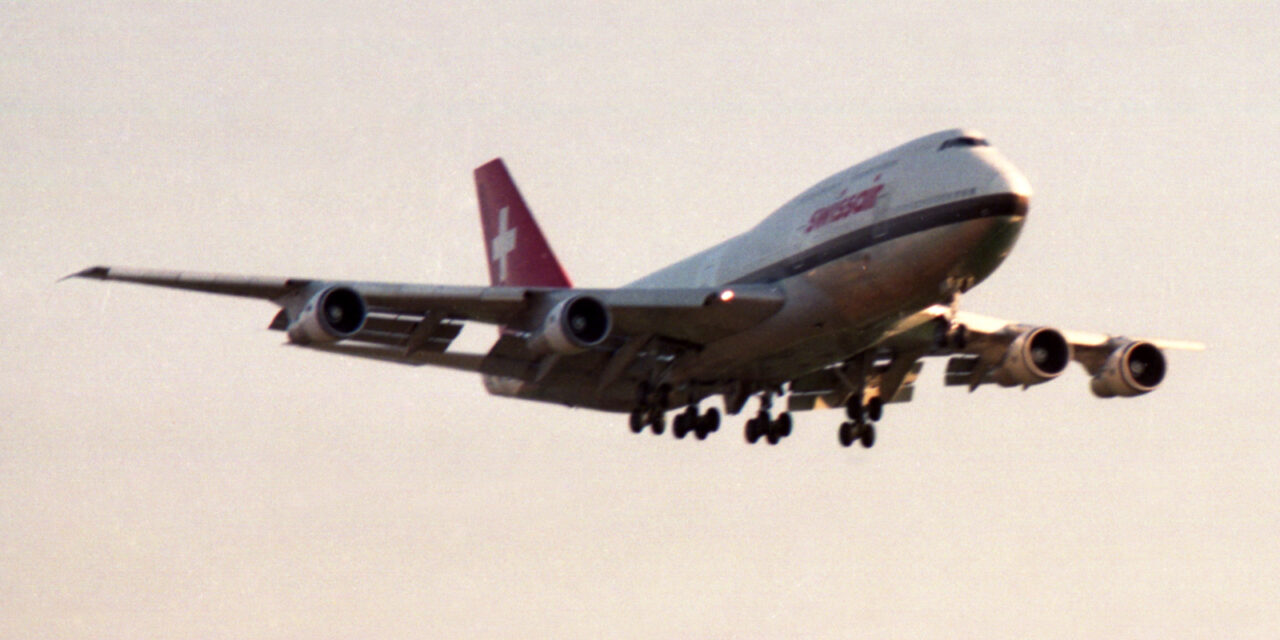
Photo: Swissair Boeing 747-357M (HB-IGC “Bern”) at Zurich Airport, 1997. Photo: Kambui / Wikimedia Commons / CC BY 2.0. No modifications made.


