
A Historical and Research-Oriented Analysis of Aviation in the James Bond Cinematic Universe (1962–2021)
Dimitris Zopounidis
Abstract
Across six decades, the James Bond film series has provided a distinctive cinematic representation of international aviation. Aircraft, airports and airlines are not merely incidental elements of the franchise; they contribute to its portrayal of technological progress, international mobility, luxury, geopolitical power and security.
This article examines the relationship between the Bond cinematic universe and the historical development of commercial aviation, drawing on aviation statistics, documented aircraft appearances, industry history and selected film sequences. Particular attention is devoted to the transition from the early jet age to supersonic travel, the evolution of premium airline services, the economic implications of aviation-related risk and the representation of airport security.
Historical evidence illustrates the profound expansion of air transport during the franchise’s lifetime. In 1962, international travel remained relatively exclusive. By 2024, scheduled aviation had developed into a global transportation system carrying approximately 4.7 billion passengers annually.
The central argument is that the Bond films provide a valuable cultural lens through which to examine aviation’s changing economic, technological and geopolitical significance. Rather than treating cinematic representations as direct evidence of industrial change, the analysis distinguishes documented historical developments from interpretative relationships between film and aviation.
Keywords: James Bond; Aviation History; Airline Economics; Jet Age; Concorde; Airport Security; Air Transport; Cultural Representation.
1. Introduction: The World According to 007
The history of James Bond is inseparable from the history of international mobility.
When Dr. No premiered in 1962, commercial jet aviation was transforming the geography of international business, diplomacy and leisure. Boeing 707s and Douglas DC-8s had made long-distance journeys faster, while airlines increasingly presented air travel as an expression of sophistication, modernity and privilege.
Ian Fleming’s fictional intelligence officer emerged as an exceptionally mobile character, crossing national borders with remarkable ease. Airports became gateways to international intrigue; aircraft represented both technological achievement and vulnerability; and airlines provided a recognisable backdrop of global connectivity.
The Bond universe developed alongside one of the most consequential transformations in twentieth-century transportation.
Yet the relationship extends beyond technological coincidence.
Bond is associated with an ideal of refined international movement: carefully selected destinations, elegant attire, discreet service and seemingly effortless transitions between cities and continents. In the early films, this image aligned closely with the prestige-oriented culture of the international airline industry.
Over subsequent decades, however, aviation changed fundamentally. Passenger markets expanded, operating models evolved, security requirements intensified and the economics of airline competition became considerably more complex.
The franchise evolved within that same historical environment.
The resulting relationship can be investigated across three interconnected dimensions: aviation as a symbol of social distinction, aviation as technological infrastructure, and aviation as an industry exposed to economic and geopolitical risk.
2. From an Exclusive Industry to Mass Global Mobility
Any assessment of aviation’s representation in Bond must begin with the industry’s actual development.
The contrast between the early 1960s and the contemporary aviation system is substantial.
Historical aviation statistics indicate that the international airline market was comparatively small when the first Bond film was released. An historical series reproduced in Worldwatch’s Vital Signs 2005 reports approximately 121 million passengers in 1962, excluding Soviet scheduled services. By comparison, the International Civil Aviation Organization (ICAO) reported approximately 4.7 billion passengers carried on scheduled services worldwide in 2024.
Although these observations differ in geographical coverage and statistical methodology, they illustrate the extraordinary transformation in the scale of global aviation.
Aviation had evolved from a relatively exclusive form of long-distance transportation into an essential component of global economic activity.
This expansion had important implications for the social meaning of flying.
In the early jet age, international air travel was frequently associated with affluence, business influence and social distinction. The ability to move rapidly between continents represented a form of privilege that was less widely accessible than it would become in subsequent decades.
As aviation expanded, the passenger market diversified considerably. Liberalisation, technological improvements, network development and changing airline business models contributed to broader access to air transportation.
At the same time, premium travel remained an important commercial segment.
Consequently, exclusivity did not disappear from the airline industry. Instead, it became increasingly associated with differentiated services, cabin products, airport facilities and personalised passenger experiences.
This distinction is particularly relevant to the Bond franchise.
The character’s association with international travel remained consistent, even as the economic and social meaning of aviation changed around him.
In this respect, Bond offers an unusually durable cultural reference point through which to examine the transformation of the airline passenger experience.
3. The Jet Age: Pan American World Airways and International Prestige
In the early Bond era, airlines represented something beyond transportation.
They offered access to a particular social and geographical world.
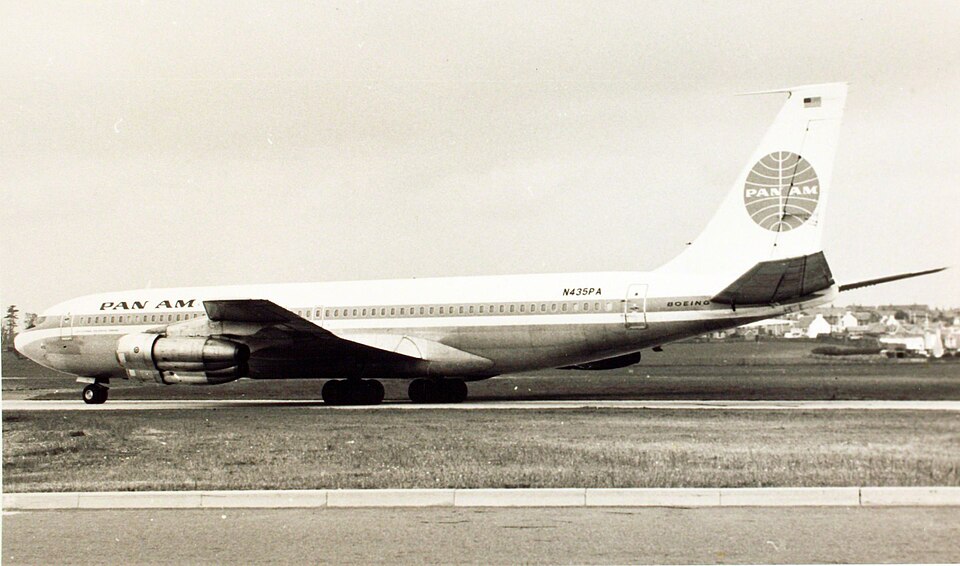
Pan American World Airways, whose aircraft and visual identity are associated with early Bond travel sequences, occupied a distinctive position within that environment.
Pan Am’s international network, technological ambitions and recognisable branding made it one of the most influential symbols of the jet age.
Its Boeing 707 operations embodied an increasingly interconnected world in which long-distance international journeys were becoming faster and more commercially feasible.
For the Bond character, this environment was entirely natural.
He operated across national boundaries, regularly moving between diplomatic, intelligence and commercial settings. The international airline system made such mobility plausible, while its premium image reinforced his characterisation as a sophisticated traveller.
Three underlying industry characteristics deserve particular attention.
First, the jet age transformed the time geography of international transportation. Higher cruising speeds reduced journey durations and changed the effective distance between major business and political centres.
Second, international air services remained strongly influenced by bilateral agreements, national carriers and regulated route structures. The commercial environment was fundamentally different from the more liberalised airline markets that emerged later.
Third, the passenger experience itself constituted a major component of airline differentiation. Cabin service, hospitality and brand presentation were central to the industry’s identity.
The Bond films did not create these characteristics. They reflected and amplified them.
The historical parallel becomes even more interesting when considered retrospectively.
Pan Am ceased operations in December 1991, demonstrating how even internationally recognised airline brands could prove vulnerable to financial pressures, competitive restructuring and changing industry conditions.
The cultural permanence of Pan Am contrasts sharply with the economic impermanence of the company.
From an aviation management perspective, the conclusion is clear: prestige and international recognition constitute valuable intangible assets, but they cannot independently guarantee sustainable airline economics.
4. Concorde and Moonraker: Technological Excellence Meets Economic Reality
The appearance of the Air France Concorde in Moonraker (1979) represents one of the most compelling intersections between the Bond franchise and aviation history.
By the late 1970s, Concorde had become one of the most recognisable achievements of commercial aerospace engineering.
Scheduled supersonic passenger services began on 21 January 1976, with Air France introducing services between Paris, Dakar and Rio de Janeiro, while British Airways inaugurated its London–Bahrain service.
For an international character associated with speed, prestige and technological sophistication, Concorde was an appropriate cinematic symbol.
However, the aircraft becomes considerably more interesting when examined through the economics of air transportation.
Concorde’s technological performance was exceptional. Nevertheless, its commercial operating model faced important limitations associated with fuel consumption, restricted operating routes, maintenance requirements, relatively limited seating capacity and the narrow market willing to pay substantial premiums for supersonic travel.
The underlying paradox is fundamental: technological superiority does not necessarily imply economic superiority.
Historical operational statistics provide a useful perspective.
A NASA-hosted study reports approximately 14,805 passengers and a load factor of 66.6% for the Air France Paris–Dakar–Rio de Janeiro Concorde service in 1979.
These figures offer an opportunity to examine actual utilisation rather than relying exclusively on the aircraft’s cultural reputation.
A load factor indicates the proportion of available passenger capacity utilised during an operation. However, it does not independently establish profitability.
Determining financial performance requires additional information concerning ticket revenue, fuel expenditure, aircraft ownership, maintenance, airport charges and indirect operating costs.
Consequently, Concorde provides a particularly valuable historical example of the distinction between engineering achievement, customer value and commercial sustainability.
Bond’s cinematic environment emphasised speed, modernity and prestige.
Airline management ultimately had to reconcile those characteristics with economic realities.
The broader lesson remains relevant to contemporary aviation innovation, particularly the renewed commercial interest in supersonic passenger transportation.
5. Aircraft as Instruments of Technological and Strategic Power
Not every aircraft appearing in the Bond universe serves a commercial transportation function.
Several aircraft are presented as extensions of military capability, technical ingenuity or tactical advantage.
In You Only Live Twice (1967), the Wallis autogyro known as Little Nellie demonstrates a distinctive form of aviation innovation.
Developed from a real autogyro design associated with Ken Wallis, the aircraft appears as a compact reconnaissance platform equipped with fictionalised defensive and offensive capabilities.
Its inclusion illustrates the cinematic fascination with aircraft miniaturisation and specialised aviation technology.
Similarly, the Bede BD-5J Acrostar featured in Octopussy (1983) represents an extraordinary example of a small jet-powered aircraft.
Its compact dimensions and high-performance characteristics made it especially suitable for a cinematic sequence emphasising agility, speed and technical ingenuity.
The Avro Vulcan bomber in Thunderball (1965) introduces another dimension: aviation as an instrument of strategic military power.
The aircraft’s role in the narrative is inseparable from Cold War concerns over nuclear weapons, military capabilities and international security.
These examples illuminate an important distinction in aviation innovation.
The technical feasibility of an aircraft design does not necessarily imply its scalability, commercial viability or operational suitability.
Experimental aircraft may demonstrate remarkable engineering achievement without becoming commercially significant transportation platforms.
This distinction is particularly relevant to contemporary discussions surrounding advanced air mobility, electric aviation and autonomous aircraft systems.
Although the technologies and operational environments differ substantially, the central managerial question remains comparable: how can technological innovation be translated into safe, certifiable and economically sustainable aviation operations?
6. Aviation Security: The Airport as Critical Infrastructure
The significance of aviation changes markedly in Casino Royale (2006).
Where earlier Bond films frequently employed aircraft as symbols of technological sophistication or luxurious mobility, Casino Royale places the airport itself at the centre of a significant security and financial threat.
The film’s fictional Miami International Airport sequence revolves around an attempted attack on the Skyfleet prototype aircraft.
The production combined physical sets, practical effects and computer-generated imagery. Although presented as Miami, substantial elements of the sequence were filmed in Prague and at Dunsfold Aerodrome in Surrey.
This distinction between the cinematic airport and the operational airport is important.
In the film, aviation infrastructure becomes the setting for a direct confrontation between an intelligence operative and a hostile actor.
In reality, major airports are highly regulated environments characterised by layered operational processes, restricted areas, coordinated security responsibilities and complex interactions among airport operators, airlines, ground handlers and government agencies.
The operational consequences of aviation-related security events are not necessarily confined to immediate physical damage.
They may extend to flight scheduling, aircraft utilisation, passenger confidence, insurance arrangements, regulatory intervention and financial markets.
Consequently, the airport should be understood as both a transportation node and a critical infrastructure asset whose operational continuity contributes to wider economic activity.
This provides one of the most interesting interpretative developments in the Bond franchise: the movement from aviation predominantly represented as freedom and international mobility toward aviation represented as an interconnected system exposed to complex security risks.
7. Casino Royale and Airline Finance: The Economics of a Manufactured Crisis
The aviation-related storyline in Casino Royale offers an unusually compelling intersection between cinema and financial economics.
The antagonist, Le Chiffre, attempts to profit financially from the anticipated destruction of a major aircraft prototype.
His strategy depends on the expectation that the resulting disruption will adversely affect the market valuation of the associated company.
This is not merely an aviation-related plot device.
It constitutes a fictional illustration of event-driven financial risk.
The financial principle can be expressed through the payoff structure of a short equity position:
Π(short) = N(P₀ − P₁) − C
Where:
- N represents the number of shares sold short.
- P₀ represents the initial sale price.
- P₁ represents the subsequent repurchase price.
- C represents transaction, financing and borrowing costs.
A reduction in the share price may generate a positive return, whereas an increase produces a loss.
The film develops this principle into a dramatic scenario in which an anticipated aviation disaster is intended to generate financial gain.
From an academic perspective, the scenario raises several important questions.
First, how strongly do major aviation incidents affect equity valuations?
Market reactions are not uniform. They depend on the nature of the event, the financial exposure of affected companies, the distribution of liability, anticipated disruptions to earnings and information already incorporated into market prices.
Second, does the financial impact remain confined to one company?
Not necessarily.
Major incidents may influence airlines, aircraft manufacturers, insurance providers, aircraft lessors and other participants across the aviation value chain.
Nevertheless, the magnitude and direction of the impact can differ substantially between companies.
Third, can the financial consequences be predicted with certainty?
No.
Even when an event has an identifiable economic impact, market responses depend on investor expectations, existing valuations, available information and subsequent developments.
The film therefore offers a valuable fictional starting point for discussing event-driven financial risk rather than an empirically reliable representation of how financial markets necessarily behave.
7.1 A potential event-study approach
A formal empirical investigation could examine abnormal equity returns surrounding documented aviation-related events.
A conventional market-model specification is:
R(i,t) = α(i) + β(i)R(m,t) + ε(i,t)
Abnormal returns can subsequently be estimated as:
AR(i,t) = R(i,t) − [α̂(i) + β̂(i)R(m,t)]
For an event window extending from t₁ to t₂, cumulative abnormal returns are calculated as:
CAR(i) = Σ AR(i,t), for t = t₁ to t₂
Such an investigation would require an appropriate estimation window, clearly defined event dates, relevant financial benchmarks and statistical tests.
Potential applications include historical aircraft programme disruptions, aviation-related security incidents and major operational crises.
Importantly, this would constitute a separate empirical investigation inspired by the film.
The fictional Skyfleet incident cannot itself serve as an observed financial market event, and no empirical abnormal-return estimates are presented in this article.
This distinction is essential to maintaining research credibility.
Cinema may generate valuable research questions, but fictional events cannot substitute for empirical evidence.
8. From Pan Am to British Airways: The Transformation of Airline Prestige
One of the most interesting changes in Bond’s aviation history concerns the evolving relationship between airline travel and social prestige.
In the 1960s, an international airline brand could communicate exclusivity through the broader experience of flying.
As passenger markets expanded, however, airlines increasingly differentiated their products through cabin classes, airport lounges, frequent-flyer programmes and premium services.
The British Airways Boeing 747 sequence in Die Another Day (2002) reflects this later commercial environment.
The emphasis is no longer exclusively on international air travel as a privileged activity.
Instead, prestige is associated with a particular experience within the wider commercial aviation system.
From an airline management perspective, this distinction is significant.
Market expansion does not necessarily eliminate premium demand. Instead, it changes the mechanisms through which premium value is created and captured.
Cabin segmentation allows airlines to differentiate products within the same flight operation.
The economic contribution of premium cabins depends on several variables, including ticket yields, seat density, demand characteristics, operating costs and network structure.
For Bond, however, premium travel retains a cultural meaning that extends beyond commercial considerations.
The character’s association with refined service, discretion and international sophistication remains fundamentally consistent.
The technology and commercial structures have changed.
The underlying appeal of effortless international mobility remains.
9. The Airport as a Geographical Expression of Globalisation
Aviation in the Bond universe can also be investigated geographically.
The franchise is international by design.
Its narratives regularly move between major metropolitan centres, remote islands, financial districts, diplomatic environments and strategically important territories.
Air travel makes these transitions narratively plausible.
Airports fulfil three identifiable cinematic functions.
First, they operate as gateways, facilitating the movement of characters across national boundaries.
Second, they function as transitional spaces connecting separate geographical and political environments.
Third, in selected films, they become operational settings for surveillance, pursuit, security incidents and direct confrontation.
A systematic geographical investigation should distinguish between these functions rather than simply count airport appearances.
Particular attention should also be given to the distinction between narrative geography and production geography.
The fictional airport represented in a film may differ considerably from the physical location where the sequence was recorded.
The Miami airport sequence in Casino Royale provides an especially clear illustration.
From a research perspective, this distinction is important for defining observational variables and ensuring geographical accuracy.
Film location information should therefore be verified through appropriate production documentation, official film archives and supporting historical sources.
10. Aviation, Geopolitics and Strategic Power
Commercial aviation has never developed independently of international politics.
The global airline system emerged through a complex interaction of national sovereignty, air service agreements, industrial policy, airport infrastructure and commercial interests.
Bond’s fictional world operates within a similarly international environment characterised by borders, intelligence activities, political influence and strategic competition.
The relationship between the franchise and aviation’s geopolitical context is not limited to passenger transportation.
Military aircraft, experimental technologies and aerospace systems appear throughout the series.
These examples should be distinguished from scheduled commercial aviation, since their institutional, regulatory and economic characteristics differ substantially.
Nevertheless, their inclusion reflects the broad strategic significance of aerospace capabilities.
Aircraft can facilitate international commerce, transport passengers, support surveillance, project military power and demonstrate technological leadership.
The Bond franchise consequently presents aviation not as a single homogeneous industry but as a diverse group of technologies and operations embedded within international relations.
This interpretation is consistent with the wider historical significance of aviation as an instrument of both economic integration and strategic influence.
11. Six Decades of Aviation: A Comparative Historical Perspective
The evolution of aviation in Bond can be examined through selected film examples and their corresponding historical environments.
| Period | Film | Aviation theme |
|---|---|---|
| 1962 | Dr. No | International jet travel |
| 1964 | Goldfinger | Private aviation and luxury |
| 1965 | Thunderball | Military aviation and strategic security |
| 1967 | You Only Live Twice | Experimental aviation |
| 1979 | Moonraker | Supersonic passenger transportation |
| 1983 | Octopussy | Miniature jet technology |
| 2002 | Die Another Day | Premium airline services |
| 2006 | Casino Royale | Aviation security and financial risk |
These cases suggest a broad historical progression from aviation represented as an emblem of mobility and prestige toward aviation represented as a technologically sophisticated and economically interconnected system.
Nevertheless, the development should not be interpreted as strictly linear.
Security concerns existed before the twenty-first century. Premium aviation remains commercially relevant today. Experimental technologies have appeared throughout the franchise.
What changes is the relative emphasis placed on particular themes and the broader industrial environment in which individual films were produced.
A rigorous empirical assessment would therefore require systematic examination of the entire film series.
12. Towards a Quantitative Analysis of the James Bond Aviation Universe
A more ambitious investigation would require the development of a structured dataset covering the 25 official EON-produced James Bond films released between 1962 and 2021.
The proposed unit of observation would be the individual aviation-related scene, nested within its corresponding film.
Each observation could incorporate the following variables:
Film characteristics: title, release year, Bond actor, film duration and scene timestamp.
Aircraft characteristics: manufacturer, aircraft model, aircraft category, propulsion type and operational role.
Airline characteristics: airline identity, visual branding, narrative context and confirmed commercial involvement.
Airport characteristics: narrative airport, actual filming location and the operational function depicted.
Operational characteristics: commercial passenger flight, private aviation, military operation, experimental flight or other aerospace activity.
Cinematic characteristics: transportation, pursuit, surveillance, luxury, technological demonstration or security-related threat.
Historical characteristics: relevant aviation developments during the release period.
Evidence characteristics: source references, verification status and uncertainty classification.
This structure would support descriptive statistics, historical comparisons and more advanced quantitative methods.
For example, the proportion of aviation scenes associated with commercial passenger transportation could be compared with the proportion involving military or experimental aircraft.
The frequency of premium-service representations could be investigated across decades.
A geographical analysis could identify major narrative destinations and distinguish them from physical filming locations.
Network analysis could also be employed to explore relationships among films, aircraft models, airline brands and airport locations.
However, any interpretation of such results would require careful consideration of sample size, variable definitions and classification uncertainty.
12.1 A proposed Aviation Representation Index
An additional methodological contribution could involve the development of a composite measure assessing the representation of aviation within individual Bond films.
The aviation representation profile of film i could be defined as:
X(i) = [T(i), L(i), S(i), G(i), E(i)]
Where:
- T represents technological emphasis.
- L represents luxury and premium-service representation.
- S represents aviation-related security content.
- G represents geographical mobility.
- E represents economic relevance.
A composite Aviation Representation Index could then be specified as:
ARI(i) = Σ w(j) × x(i,j)
Subject to the conditions that the weights are non-negative and sum to one.
The development of such an index would require carefully defined indicators, appropriate normalisation procedures and a transparent weighting methodology.
Equal weighting could provide an initial benchmark.
Alternative weighting assumptions could then be evaluated through sensitivity analysis.
Inter-coder agreement would also need to be assessed before treating classification results as reliable.
The resulting index would not measure the artistic quality of a film or establish an objective ranking of cinematic realism.
Its purpose would be to provide a transparent analytical representation of selected aviation-related characteristics.
No index values are reported in this article because a complete empirical dataset has not yet been constructed.
13. Research Limitations
Several limitations should be recognised.
First, cinema does not constitute a statistically representative record of aviation industry development.
Aircraft, locations and technologies are selected primarily according to narrative, aesthetic and production requirements.
Second, historical aviation statistics may differ in geographical coverage, carrier definitions and reporting methods.
Long-term comparisons therefore require harmonisation before precise growth estimates can be established.
Third, the appearance of an airline or aircraft in a film does not necessarily imply a formal commercial partnership.
Brand visibility, sponsorship and production assistance should be independently verified.
Fourth, the distinction between fictional geography and actual filming geography is essential.
Finally, the temporal coexistence of aviation developments and cinematic representations does not establish a causal relationship between them.
These limitations do not diminish the research potential of the subject.
Rather, they define the methodological standards necessary for a scientifically credible investigation.
14. Conclusion: Aviation as a Reflection of Modernity
The relationship between James Bond and aviation extends considerably beyond a collection of memorable aircraft appearances.
Since 1962, the franchise has accompanied the transformation of air transportation from an expanding, prestige-oriented international industry into a complex global transportation system.
The early jet age provided Bond with an environment of elegance, technological optimism and international mobility.
Concorde represented the extraordinary ambitions of supersonic transportation.
Experimental aircraft reflected the fascination with engineering innovation.
Modern airport sequences introduced questions of security, financial exposure and systemic vulnerability.
Across these developments, one theme remains remarkably consistent.
Aviation represents the ability to transcend geographical distance and participate in an interconnected international world.
For Bond, that ability appears almost effortless.
For the aviation industry, it has required decades of technological investment, infrastructure development, regulatory coordination and commercial adaptation.
The contrast between these two perspectives is what makes the subject especially compelling.
The cinematic passenger experiences sophistication, speed and freedom.
The aviation researcher observes fleet economics, network connectivity, operational complexity, security requirements and risk.
Both perspectives contribute to a broader understanding of the significance of flight.
Ultimately, the enduring relationship between James Bond and aviation reflects something larger than the franchise itself: the way modern societies have imagined technological progress, international mobility and the possibilities of global connectivity for more than six decades.
Aircraft have changed. Airlines have disappeared, while new competitors have emerged. Airports have become increasingly sophisticated and operationally complex.
Yet the fascination with international flight remains.
And in the world of James Bond, that fascination continues to represent one of the most enduring expressions of modernity.
References and Historical Sources
International Civil Aviation Organization (ICAO). (2024). The World of Air Transport in 2024. ICAO Annual Report. https://www.icao.int/about-icao/AnnualReport2024/world-air-transport-2024
World Bank. (n.d.). Air transport, passengers carried. World Development Indicators. https://data.worldbank.org/indicator/IS.AIR.PSGR
Ausrotas, R. A. (1981). Predicting the impact of new technology aircraft on international air transportation demand. NASA Contractor Report 165654. https://ntrs.nasa.gov/api/citations/19810022618/downloads/19810022618.pdf
Chafe, Z. (2005). Air travel slowly recovering. In Vital Signs 2005. Worldwatch Institute. https://www.issuelab.org/resources/131/131.pdf
Heritage Concorde. (n.d.). Concorde first scheduled services. https://www.heritageconcorde.com/concorde-first-scheduled-services
James Bond 007. (n.d.). You Only Live Twice: Little Nellie. Official James Bond Archive. https://www.007.com/you-only-live-twice-2/
James Bond 007. (n.d.). Focus of the Week: The Acrostar “Bede” Jet. Official James Bond Archive. https://www.007.com/focus-of-the-week-the-acrostar-bede-jet/
007 Magazine. (n.d.). Casino Royale 20th Anniversary. https://007magazine.co.uk/news_cr20-1.htm
Editorial note: This article combines documented aviation history, selected film examples and an explicitly interpretative analytical framework. The quantitative research design is proposed rather than executed. A complete film-level dataset, formal empirical testing and comprehensive verification of all aircraft and airline appearances would be necessary before presenting the work as an original quantitative study.
Pan American World Airways Boeing 707. Photo: San Diego Air & Space Museum Archives / Wikimedia Commons (CC0 1.0).


