
In 2025, Etihad Airways delivered the strongest financial performance in its history, reporting a net profit of AED 2.6 billion (US$698 million), a 47% increase year-on-year.
Total revenue rose to AED 30.7 billion (US$8.4 billion), up 21%, supported primarily by passenger revenue of AED 25.8 billion (+24%), while cargo contributed AED 4.5 billion (+8%).
These figures matter not simply because they are record-breaking, but because of the way they were achieved.
The airline carried 22.4 million passengers in 2025, marking a 21% increase compared to the previous year. At the same time, capacity expanded significantly, reaching 111.5 billion Available Seat Kilometers (ASK). Crucially, this expansion did not dilute efficiency: the load factor improved to 88.3%, up roughly two percentage points year-on-year.
From an operational perspective, growing both capacity and load factor simultaneously signals demand absorption rather than forced expansion. In aviation economics, this balance between supply (ASK) and demand (RPK) is fundamental for protecting yields and sustaining margins.
Etihad’s profitability profile further reinforces this structural narrative. The airline reported EBITDA of AED 6.3 billion (US$1.7 billion), a 37% increase, with an EBITDA margin of 20%, up two percentage points. Operating cash flow reached nearly AED 8 billion, strengthening liquidity and supporting capital expenditure without destabilizing the balance sheet.
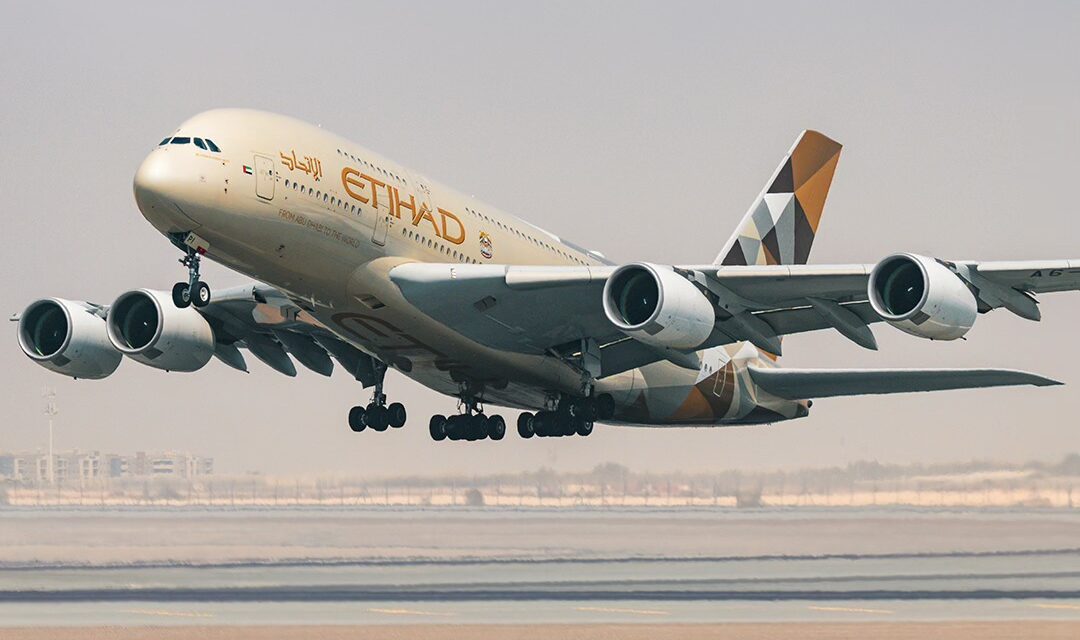
Fleet and network strategy were central to this performance. The operating fleet expanded to 127 aircraft, the largest in the airline’s history, following the addition of 29 aircraft during the year, including Airbus A321LRs, A350s, Boeing 787s, and reactivated A380s. The network grew from 94 to 110 destinations, while annual landings exceeded 105,000, compared to 90,000 the previous year.
This scale expansion, however, appears calibrated rather than opportunistic. Modern widebody aircraft such as the Boeing 787 and the Airbus A350 enhance fuel efficiency and reduce unit operating costs, directly influencing cost per available seat kilometer (CASK) and break-even load factors.
Cargo performance added an additional stabilizing component. Volumes rose 9% to more than 700,000 tonnes, supported by expanded belly capacity and increased activity on Asia–Middle East corridors, particularly China.
Equally significant is the evolution of Abu Dhabi’s role within the airline’s demand structure. Point-to-point traffic to Abu Dhabi reached 5.5 million passengers, up from 4.6 million in 2024, while the stopover program attracted 170,000 visitors, more than double the prior year. This indicates a strengthening local demand base alongside transfer flows, reducing overdependence on pure hub connectivity.
Finally, the airline received a credit rating upgrade to AA- by Fitch, reflecting improved financial resilience and capital discipline.
Taken together, the 2025 results suggest more than cyclical recovery. They indicate improved alignment between fleet efficiency, capacity growth, yield management, and capital structure. In a sector defined by thin margins and volatility, this alignment determines sustainability.
Etihad’s strongest year is therefore best understood not as a peak, but as evidence of a maturing operating model grounded in economic discipline and data-driven execution.


