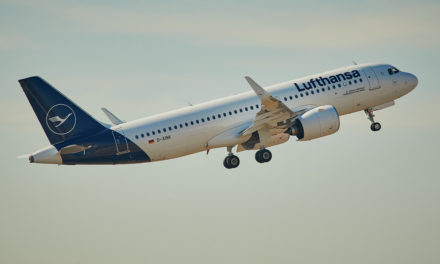

Lufthansa’s departure from the Airbus A340-600 illustrates a difficult airline management decision: when does an aircraft’s remaining commercial value stop justifying its operating costs?
The airline confirmed earlier in 2026 that its last four A340-600s would leave the fleet in October. Flightradar24 subsequently identified LH419 from Washington Dulles to Frankfurt, departing on 18 October and scheduled to arrive the following morning, as the final planned service. That schedule marks the expected conclusion of almost 23 years of operations, rather than independent confirmation of the flight’s completion.
The more revealing story concerns the changing balance between fuel efficiency, premium revenue and the cost of maintaining a small aircraft subfleet.
A shrinking fleet, with a continuing commercial role
Lufthansa operated 24 A340-600s over the type’s history, with deliveries between November 2003 and May 2009. The final four therefore represented 16.7% of that historical total, an 83.3% reduction in aircraft numbers. This measures the contraction of the subfleet, rather than a corresponding reduction in passenger capacity or flying activity.
The aircraft’s continued usefulness was demonstrated in June 2021. Lufthansa announced that five A340-600s would return temporarily to support Munich’s premium offering from summer 2022. Each carried eight First Class seats, and the airline explicitly linked reactivation to recovering premium demand. Before the pandemic, its A340-600 fleet had comprised 17 aircraft.
That decision provides an important qualification to the usual explanation of aircraft retirement. Fuel consumption matters, but fleet decisions also depend on what an aircraft can sell.
An older aircraft can retain commercial value when it offers a cabin product that available replacements cannot immediately provide. Lufthansa’s reactivation decision suggests that, at that point, preserving premium capacity justified temporarily returning the type to service. It does not establish the profitability of individual flights.
What a 25% fuel advantage actually means
Lufthansa Group has previously stated that its new A350-900s and Boeing 787-9s consume approximately 25% less kerosene than four-engine aircraft. This is a broad fleet renewal benchmark, rather than a measured saving for every A340-600 route.
An indexed calculation illustrates its economic significance:
| Illustrative fuel comparison | Older aircraft | Replacement aircraft |
|---|---|---|
| Fuel required for a comparable mission | 100 | 75 |
| Fuel expenditure at the same fuel price | 100 | 75 |
| Fuel expenditure after a 20% price increase | 120 | 90 |
Illustrative calculations using an assumed 25% reduction in mission fuel. These are not observed Lufthansa flight costs.
Under these assumptions, a replacement aircraft facing fuel prices 20% higher would still spend 10% less on fuel than the older aircraft at the original price.
The calculation explains why fuel efficiency becomes particularly valuable when prices rise. It also shows why a 25% reduction in fuel consumption cannot be reported as a 25% reduction in total operating costs. Aircraft ownership, financing, crews, maintenance and airport charges remain separate components of the cost base.
The relevant investment question is whether operating savings and additional revenue exceed the cost of introducing the replacement aircraft.
Why the last four aircraft matter
Retiring a complete subfleet changes more than the number of aircraft available.
A distinct aircraft type requires training, technical support, spare parts and operational planning. Some associated costs can decline with fleet size, while others remain necessary for as long as the type operates. Consequently, removing the final aircraft can create opportunities that withdrawing a few aircraft from a larger subfleet does not.
Lufthansa Group’s 2025 annual report places this logic within its wider strategy. It plans to reduce the number of long-haul aircraft types from 13 to ten, a calculated decline of 23.1%. The Group identifies crew training, maintenance and operations as areas where simplification should generate savings. These figures concern the Group’s broader programme, rather than Lufthansa Airlines alone.
A 23.1% reduction in aircraft types does not imply an equivalent reduction in costs. It indicates the scale of planned simplification; the financial benefit depends on how much supporting infrastructure can actually be consolidated.
Retirement also means capacity discipline
The October withdrawal formed part of a wider response to cost pressures.
In its April announcement, Lufthansa Group combined the retirement of four A340-600s with the winter grounding of two Boeing 747-400s. It described a reduction of six intercontinental aircraft at the end of the summer schedule, alongside other network measures.
This distinction matters when interpreting fleet renewal. An aircraft leaving service does not necessarily receive an immediate, one-for-one replacement on the same route. Airlines can redistribute newer aircraft, adjust frequencies and alter capacity across their networks.
For passengers and airports, the relevant outcome is therefore the resulting timetable, seat supply and cabin mix. Aircraft counts alone cannot establish whether a particular market gains or loses connectivity.
Efficiency needs the right denominator
The environmental assessment also requires care.
Lower fuel consumption on a comparable mission reduces combustion-related CO₂ emissions. Emissions per passenger, however, also depend on occupancy and cabin configuration.
In a hypothetical comparison with equal seat capacity and distance, an aircraft using 25% less fuel but operating at a 70% load factor would consume approximately 8.9% less fuel per passenger than the older aircraft at an 85% load factor. The calculation is (0.75 × 0.85 ÷ 0.70 = 0.911).
The aircraft remains more efficient in this example, but the passenger-level improvement is smaller than the aircraft-level saving. Network growth can also offset efficiency improvements in absolute emissions.
Lufthansa’s A340-600 withdrawal brings these considerations together. The aircraft retained value when premium capacity was scarce. Its eventual exit supports lower fuel requirements and a simpler fleet, while the wider capacity programme reflects the pressure to match flying activity to operating economics.
Assessing the success of that transition will require more than counting retired aircraft. The meaningful measures are fuel consumption, operating cost, revenue quality and emissions relative to the transport service delivered.
Methodological note: Percentage changes and indexed scenarios are author calculations. No proprietary route profitability, aircraft maintenance cost or realised fuel-burn data were available for this analysis.