
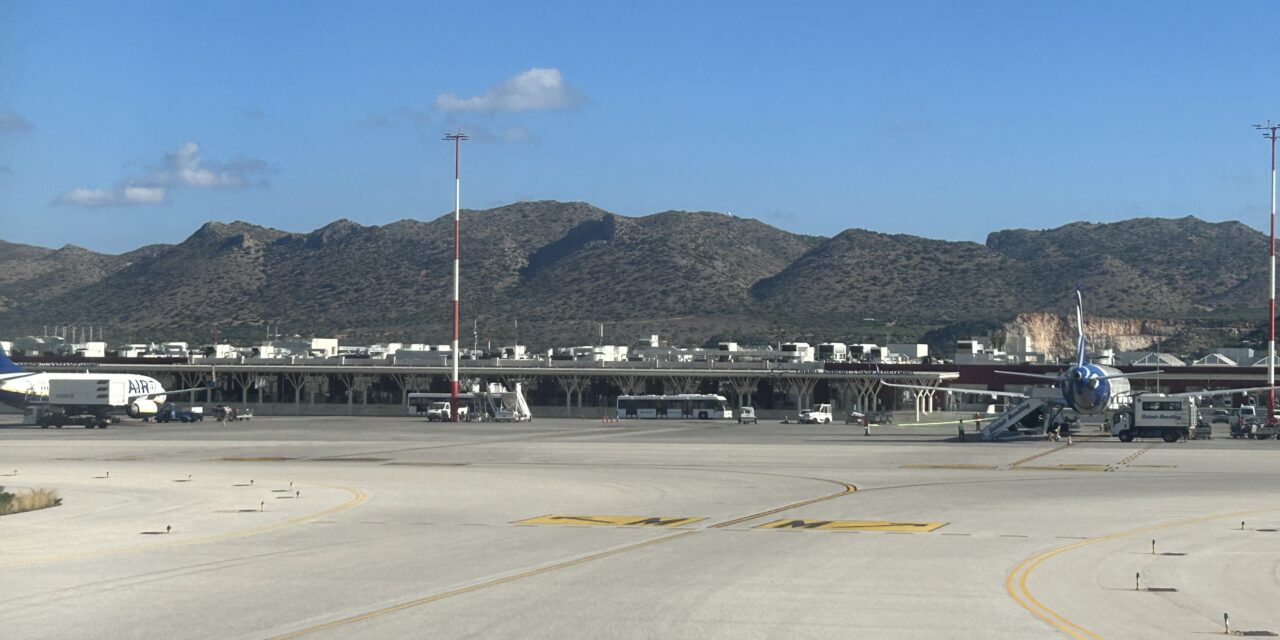
Traffic growth, connectivity and environmental performance are usually discussed separately. Airports, however, operate as complex systems and sustainability may depend less on any single metric than on how those dimensions interact.
By Dimitris Zopounidis
Founder, Crete Aviation Observatory
PhD Candidate, Technical University of Crete
Airport Sustainability | Aviation Analytics | Decision Intelligence

Airports are relatively easy to measure.
Passenger numbers can be counted. Aircraft movements can be tracked. Routes can be mapped. Traffic growth can be compared from one year to the next.
Sustainability is considerably harder.
For years, the aviation debate has understandably focused heavily on environmental performance. Carbon emissions, energy consumption and decarbonisation remain fundamental questions for the sector.
But an airport is not simply an environmental footprint.
It is also transport infrastructure, a regional economic gateway, an airline network, a tourism access point and a system that connects passengers, communities, businesses and destinations.
That distinction matters.
An airport can record strong traffic growth while becoming increasingly dependent on a small number of markets.
It can expand the number of destinations it serves without necessarily improving the resilience of its network.
It can appear highly connected while individual markets differ significantly in operational depth and frequency.
And it can pursue ambitious environmental policies without those policies necessarily becoming a decisive factor in passenger behaviour.
The challenge, therefore, is not simply to ask whether an airport is growing.
It is to understand what kind of growth is taking place, how resilient that growth is and whether the wider airport system is developing sustainably over time.
Looking beyond the headline traffic number
Recent aviation data from Chania provide an interesting illustration.
Throughout the 2026 summer season, Chania Airport maintained a broad international source-market portfolio. The Crete Aviation Observatory’s monthly analysis has repeatedly treated this geographical diversification as strategically important because a broader distribution of demand can reduce dependence on individual markets.
This is not simply a tourism statistic.
It is a question of resilience.
A network dominated by a small number of markets may perform extremely well during favourable conditions but remain more exposed to airline capacity decisions, economic weakness or geopolitical disruption within those markets.
A more diversified demand structure can potentially absorb shocks differently.
That does not mean that diversification automatically equals sustainability. It means that the composition of traffic matters alongside its absolute volume.
The same principle applies to connectivity.
A route map can show where an airport is connected.
It does not necessarily show how strongly it is connected.
During August 2026, for example, Chania recorded substantial differences in aircraft movements between its international markets. The United Kingdom accounted for 681 movements, Germany for 469, Poland for 361, Denmark for 327 and Norway for 271.
These figures provide another layer of information beyond passenger totals, helping describe the operational intensity of individual market relationships.
Passenger volumes and aircraft movements therefore answer different questions.
Traffic tells us something about demand.
Operations tell us something about the structure supporting that demand.
For airport analysis, the distinction can be important.
Beyond scale
A further challenge is that airport performance is often influenced by size.
Large airports naturally handle more passengers, more flights and greater absolute volumes of activity.
But scale does not necessarily translate into sustainability performance.
Recent research conducted at the Technical University of Crete examines airport sustainability through a broader multicriteria perspective, incorporating environmental, infrastructural, accessibility, socioeconomic and operational dimensions.
The analysis also adjusts for size-related effects, allowing airports with very different traffic volumes and operating characteristics to be compared more meaningfully.
This distinction is important.
A busy airport is not automatically a sustainable airport.
And a smaller regional airport should not automatically appear weaker simply because it handles fewer passengers.
The question is not simply one of scale.
It is one of balance.
Sustainability and the passenger
There is another complication.
Passengers themselves do not necessarily evaluate sustainability in the same way that institutions, regulators or airport operators do.
The 2026 passenger research conducted by the Crete Aviation Observatory at Chania Airport included 1,122 observations and examined airline choice, experience, value for money, travel characteristics and environmental perceptions.
One result is particularly revealing.
Only 15.1 per cent of respondents reported that an airline’s environmental policy strongly influenced their choice, while the average score for environmental influence was 2.18 out of 5.
By comparison, passenger satisfaction and perceptions of value for money displayed a much stronger relationship.
This should not be interpreted as evidence that environmental performance does not matter.
Quite the opposite.
It illustrates why airport sustainability cannot be understood solely through passenger preferences.
Environmental responsibility, consumer behaviour, economic performance and operational reality can move at different speeds.
For airport managers and policymakers, that creates a difficult balancing problem.
Airports are systems
The more airport data are examined together, the harder it becomes to defend sustainability as a single-dimensional concept.
Environmental performance matters.
But so does economic resilience.
Passenger accessibility matters.
So does the depth and stability of the airline network.
Operational efficiency matters.
So do the social and regional functions that an airport supports.
These dimensions coexist inside the same infrastructure system, and occasionally they pull in different directions.
A highly efficient airport may still face environmental challenges.
A fast-growing airport may still be commercially vulnerable.
A geographically diversified airport may still have strongly seasonal traffic.
A network with many destinations may still depend heavily on a small number of airline operators.
Recent longitudinal research on 14 Greek regional airports between 2018 and 2024 also shows that sustainability performance is not static.
Relative airport performance changes over time, with some airports maintaining consistently strong positions while others improve or decline more substantially from one year to the next.
This has an important implication.
Sustainability leadership should not be viewed as permanent.
Airports operate within changing systems.
Demand changes. Infrastructure utilisation changes. Airline networks change. Accessibility changes. Environmental performance changes.
So the sustainability assessment must evolve as well.
Different dimensions, different trajectories
Longitudinal analysis also reveals something else.
Improvements do not occur uniformly across all dimensions.
The research shows that the COVID-19 period had a negative effect on overall airport sustainability performance, followed by a strong rebound from 2021 onwards.
That recovery was driven particularly by improvements in environmental performance and accessibility, while infrastructure remained a more challenging area.
This distinction matters.
An airport system can improve overall while still carrying weaknesses beneath the headline result.
That is precisely why a single metric can be misleading.
A sustainability score becomes far more meaningful when the performance of its underlying dimensions is understood together.
From airport statistics to airport intelligence
This is where conventional airport statistics begin to reach their limits.
The sector does not lack data.
Airports already generate enormous volumes of information.
The real value increasingly lies in understanding relationships between indicators and turning them into decision intelligence.
Which growth patterns improve resilience?
Which routes strengthen an airport’s network structure?
Where does operational expansion create economic value?
When does growth begin to create environmental or infrastructure pressure?
How should accessibility be evaluated alongside emissions?
And how should those trade-offs be assessed when stakeholders do not necessarily assign the same importance to every dimension?
These are not questions that can be answered by one passenger-growth figure or one environmental KPI.
They require a broader understanding of the airport as a system.
Recent research also suggests that robust sustainability assessment does not necessarily require one single, fixed set of assumptions.
Airport performance can be tested under alternative configurations of criterion importance and model parameters, allowing researchers and decision-makers to examine whether the broad conclusions remain stable when reasonable assumptions change.
That is an important distinction.
Sustainability assessment should not depend simply on selecting the “right” indicator or assigning one supposedly perfect set of weights.
It should also ask whether the conclusion remains credible when the assumptions change.
A broader research question
This question increasingly sits at the centre of my doctoral research at the Technical University of Crete:
How should airport sustainability actually be assessed when environmental, economic, social and operational dimensions interact simultaneously?
The intention is not to replace traditional airport indicators.
It is to understand how they can be interpreted together.
The initial findings point to a broader conclusion: sustainability leadership is dynamic rather than permanent, and strong performance requires continuous improvement across multiple dimensions.
Chania provides a particularly interesting empirical environment for this type of thinking: a strongly seasonal airport, a broad European source-market structure, significant airline diversity and close interaction between aviation and the regional tourism economy.
But the underlying question extends far beyond Crete.
Airports across Europe are being asked to grow, remain competitive, improve connectivity, enhance accessibility, reduce environmental impacts and support their regional economies, often at the same time.
Measuring each objective separately is relatively straightforward.
Understanding the trade-offs between them is not.
And that may ultimately be the real sustainability challenge.
The future of airport analytics may not depend on more data. It may depend on better ways of understanding how the data fit together.
This analysis forms part of a broader research agenda on airport sustainability assessment, aviation analytics and data-driven airport decision-making. Initial findings from the airport sustainability assessment research were presented with Professor Michalis Doumpos at the 102nd Meeting of the European Working Group on Multiple Criteria Decision Aiding at ETH Zurich.


