
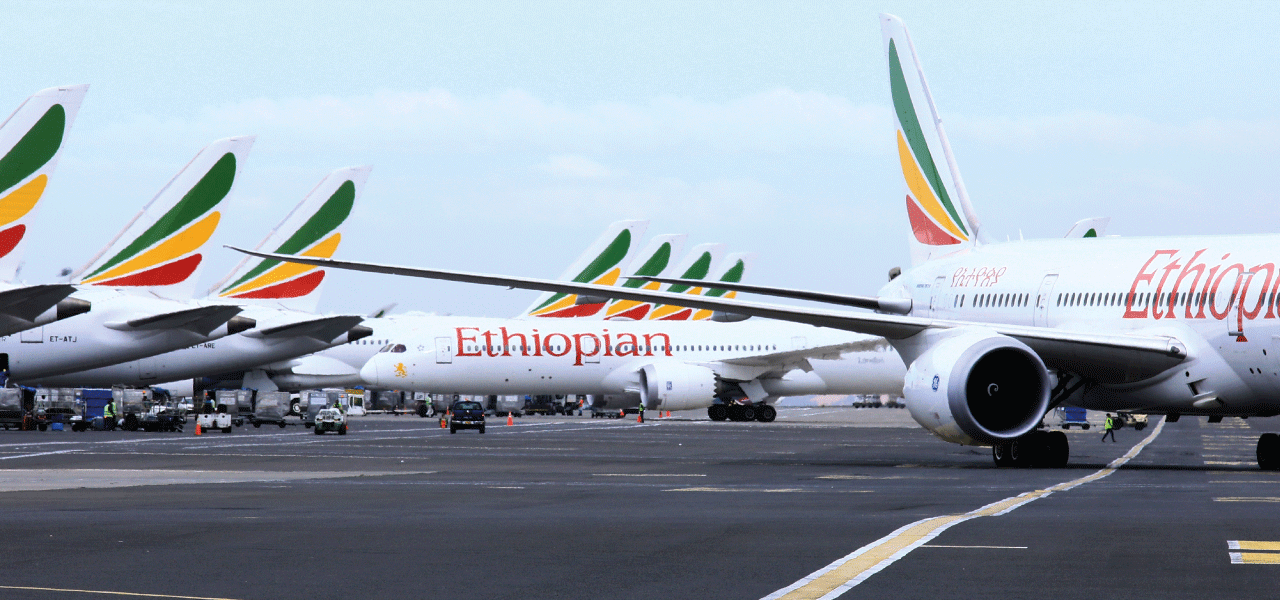
Africa’s largest airline is deepening its widebody growth strategy, confirming six more Boeing 787-9 Dreamliners as it positions itself for further intercontinental expansion and long-term hub development.
Ethiopian Airlines has confirmed the purchase of six additional Boeing 787-9 Dreamliners, strengthening its long-haul fleet strategy at a time when the carrier continues to expand its international footprint. According to Reuters, the airline is converting six previously held options into firm orders, adding to its earlier Boeing 787 commitments.
The latest move brings Ethiopian Airlines’ recent 787 order activity into sharper focus. Reuters reported that the airline had previously ordered 20 new 787s, including nine announced in January 2026, and that deliveries from the broader batch of 26 aircraft are expected to begin in 2028. Ethiopian Airlines has also stated that the newly confirmed 787-9s will support further intercontinental expansion from Addis Ababa while also increasing cargo capacity on long-haul operations.
From a strategic perspective, the order underlines Ethiopian Airlines’ intention to preserve and strengthen its role as the leading aviation hub operator on the African continent. CEO Mesfin Tasew told Reuters that the airline sees opportunities both on existing mature routes and on markets it has not yet been able to serve adequately due to aircraft shortages, explicitly mentioning Australia as an example. He also said the carrier aims to expand long-haul flying across Africa and to the United States, Europe, and Asia.
The choice of the 787-9 is consistent with a network model built around fuel-efficient widebody aircraft capable of operating long sectors with lower trip costs and improved flexibility compared with older-generation long-haul jets. In practical terms, this gives Ethiopian Airlines more room to scale frequencies, develop new intercontinental links, and support hub connectivity through Addis Ababa without relying solely on very large aircraft. This is an inference based on the aircraft type and the airline’s stated network objectives.
The fleet decision also fits into a broader infrastructure vision. Reuters reported that Tasew discussed the airline’s $12.5 billion airport project in Bishoftu, which is expected to become Africa’s largest airport when completed in 2030. The planned facility is designed for 60 million passengers and is intended to significantly exceed the capacity of Addis Ababa’s current main airport, which Ethiopian says could reach its operational limits within the next two to three years.
This matters because fleet growth and hub infrastructure are increasingly inseparable in global aviation strategy. Ethiopian Airlines is not simply adding aircraft; it is building the operational foundation for a larger transfer network, greater long-haul reach, and stronger competitive positioning between Africa, Europe, Asia, and potentially Oceania. In that sense, the additional 787-9s represent more than a fleet update. They are part of a wider attempt to scale Addis Ababa into one of the most important aviation gateways in the Global South.
Why this matters
The order sends a clear signal that Ethiopian Airlines remains one of the most ambitious network carriers in emerging aviation markets. At a time when aircraft availability has become a strategic constraint across the industry, securing additional widebody capacity gives the airline a stronger position to defend its hub model and pursue new long-haul opportunities over the coming decade.


