
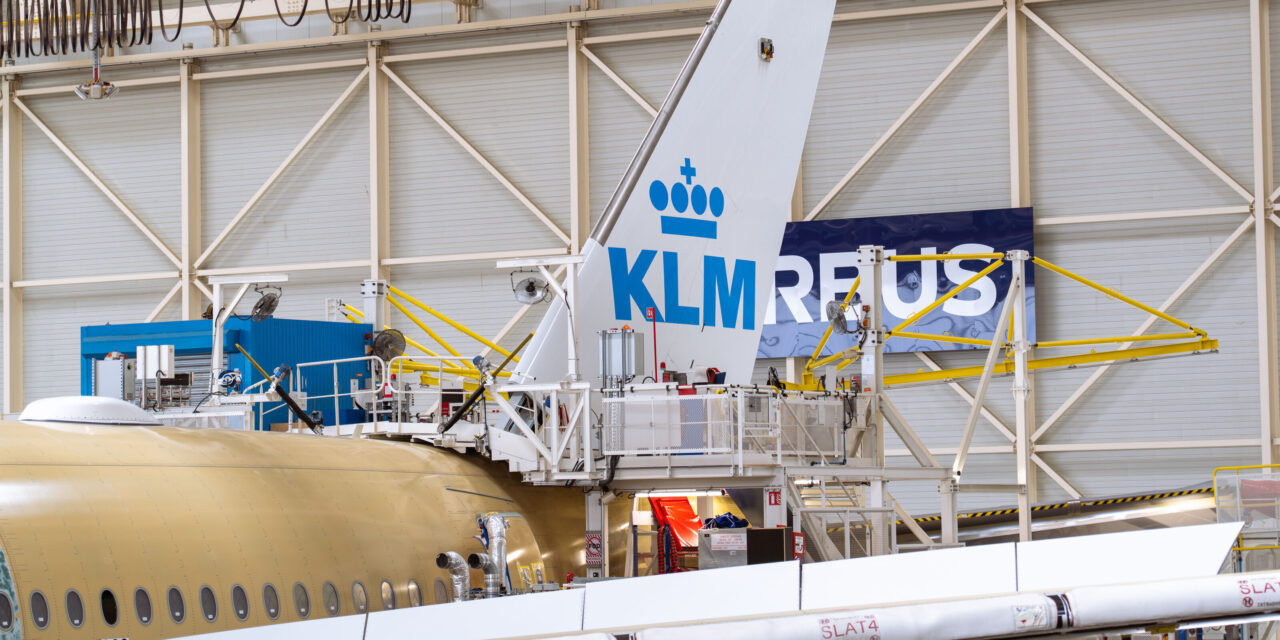
KLM’s upcoming delivery of its first Airbus A350 is not simply a fleet milestone. It represents a decisive shift in the airline’s long-haul strategy, as the Dutch carrier moves toward a new generation of widebody aircraft designed around lower operating costs, improved environmental performance, and a more modern onboard product.
The first aircraft is now on Airbus’ final assembly line in Toulouse, and KLM expects delivery before the end of summer 2026.
From a strategic standpoint, the importance of the A350 lies in what it is meant to replace. According to KLM, the A350 family will gradually take over the role currently held by the Airbus A330-200, A330-300, and part of the Boeing 777-200ER fleet. That makes the program central to the airline’s medium-term fleet restructuring rather than a symbolic addition. Two more A350s are expected to join the fleet within 2026, while the A350 freighter is planned to enter service in 2027, supporting cargo fleet modernization as well.
Operationally, the aircraft gives KLM a stronger platform for long-haul efficiency. The A350 is expected to burn around 25% less fuel than the Boeing 777-200ER and to deliver a significantly smaller noise footprint, which KLM says is about 40% lower. In today’s market, these are not secondary benefits. Fuel remains one of the largest cost items for network carriers, while environmental pressure across European aviation continues to shape both investment choices and fleet planning priorities. In that context, the A350 becomes a tool of competitiveness as much as a sustainability asset.
There is also a clear product dimension behind this transition. KLM highlights the A350’s quieter cabin, improved air quality, and higher cabin pressure, all of which matter in long-haul passenger experience. At the same time, the aircraft’s fully digital cockpit offers operational advantages for pilots and supports a more modern flight deck environment. This combination shows that fleet renewal is increasingly judged not only by economics, but also by the consistency of the customer proposition and the technological capabilities available to crews.
What makes this development especially notable is that KLM has historically been more closely associated with Boeing on the long-haul side. The arrival of the A350 therefore signals more than a routine procurement step; it reflects a recalibration of fleet architecture at a time when airlines are under pressure to balance cost discipline, emissions performance, and service quality.
Overall, KLM’s first A350 should be viewed as the opening phase of a broader structural transition. For the airline, this is not just about receiving a new aircraft type. It is about reshaping the economics and operating profile of long-haul flying for the next decade.