
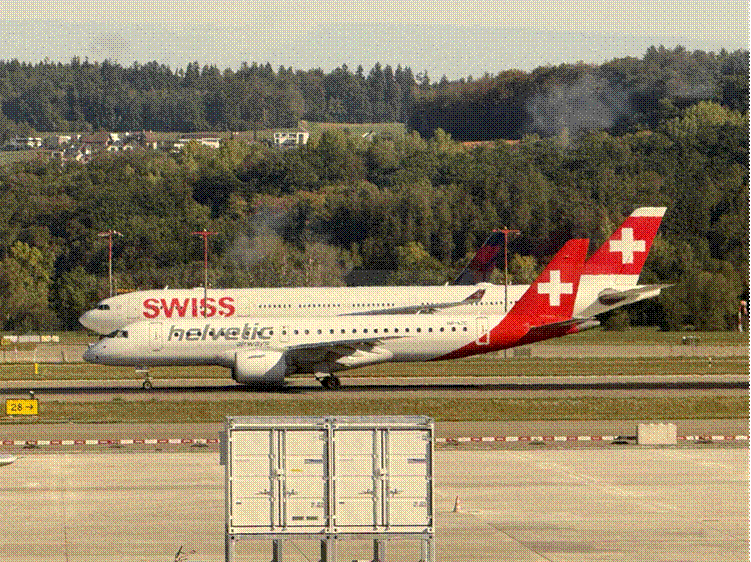
Swiss International Air Lines (SWISS) reported a 5.3% increase in operating income to CHF 4.38 billion for the first nine months of 2026, supported by resilient passenger demand, stronger premium travel yields and favorable cargo performance. However, rising fuel costs absorbed much of the additional revenue, limiting growth in operating profit despite continued cost-control measures.
© Photo by Dimitris Zopounidis | September 20, 2026, Zürich Airport.
Swiss International Air Lines (SWISS) recorded an Adjusted EBIT of CHF 421.4 million between January and September 2026, compared with CHF 411.2 million during the corresponding period of 2025, representing an increase of 2.5%. Operating income rose from CHF 4.17 billion to CHF 4.38 billion, highlighting a divergence between revenue growth and profitability as the airline navigates higher operating expenses.
The results, published on 3 November 2026, indicate that SWISS maintained its earnings performance despite inflationary pressures on key cost components, particularly aviation fuel. While demand remained strong across its network, the additional revenue generated during the period was largely offset by increased fuel expenditure.
Based on the reported figures, the airline’s Adjusted EBIT margin stood at approximately 9.6%, compared with 9.9% in the first nine months of 2025. The decline of approximately 0.3 percentage points suggests that revenue expansion has not translated into a corresponding improvement in operating profitability.
Third-Quarter Performance Strengthens Despite Lower Passenger Volumes
SWISS delivered stronger financial results during the third quarter, traditionally an important period for European airline profitability.
Operating income increased by 8.9% year-on-year to CHF 1.61 billion, while Adjusted EBIT rose by 7.4% to CHF 232.1 million, compared with CHF 216.2 million in the third quarter of 2025.
The third-quarter Adjusted EBIT margin reached approximately 14.4%, slightly below the 14.6% recorded a year earlier. This indicates that the airline achieved higher absolute operating earnings while experiencing a modest contraction in its profit margin.
The improvement came despite a 2.7% reduction in passenger numbers, from approximately 5.4 million to 5.2 million. The number of flights operated declined by 1.1% to approximately 39,100.
Available seat kilometer capacity remained unchanged, while revenue passenger kilometers declined by 3.2%. Consequently, the seat load factor decreased by 2.8 percentage points compared with the third quarter of 2025.
The combination of higher operating income and lower passenger traffic points to the importance of pricing, revenue mix and non-passenger revenue streams in the airline’s financial performance. SWISS specifically identified encouraging yield developments in premium cabins and on long-haul routes, although the published figures do not allow the individual contribution of these factors to be quantified.
Passenger Traffic Declines as Capacity Remains Constrained
Across the first nine months of 2026, SWISS transported approximately 13.7 million passengers, down 0.7% year-on-year.
The airline operated around 106,500 flights, representing a 3.0% reduction from approximately 109,900 services during the same period in 2025.
Available seat kilometers declined by 0.5%, while revenue passenger kilometers decreased by just 0.1%. As a result, the systemwide seat load factor improved by 0.4 percentage points.
These figures suggest that SWISS maintained relatively stable capacity utilization despite operating fewer flights. The smaller decline in available seat kilometers compared with flight volumes is also consistent with a shift in average capacity deployed per flight, although the published data do not establish the precise contribution of aircraft size, route distance or network composition.
The airline attributed continuing operational constraints primarily to shortages of pilots and engines within its short-haul fleet.
Operational performance remained mixed. Departure punctuality improved by 0.8 percentage points to 69.0%, while operating stability declined by 0.9 percentage points to 96.9%. According to SWISS, extreme weather events during the summer contributed to operational disruption.
Cargo Operations Provide Additional Earnings Support
SWISS WorldCargo emerged as a positive contributor to the airline’s performance during the first nine months of 2026.
The cargo division benefited from strong demand on routes connecting Asia with the airline’s international network, generating higher earnings contributions than management had anticipated.
Although SWISS did not disclose separate cargo revenue or operating profit figures in its announcement, the development underscores the strategic importance of airfreight as a complementary source of income.
For network airlines operating long-haul passenger services, cargo activity can contribute to the commercial performance of existing aircraft capacity. In the case of SWISS, stronger airfreight demand provided additional support during a period characterized by rising operating costs.
Fuel Prices Remain the Principal Financial Risk
Fuel expenditure represented the central constraint on SWISS’s earnings development during the reporting period.
According to Chief Financial Officer Dennis Weber, the airline’s additional revenue broadly matched its additional fuel expenses, preventing a more substantial improvement in operating profit.
The company indicated that jet fuel prices had returned close to the peak levels observed following the outbreak of the war in Iran. SWISS also reported that kerosene prices were approximately twice their level at the beginning of 2026.
Management expects these elevated costs to exert further pressure on financial performance during the fourth quarter and into 2027.
The airline has introduced cost-reduction and efficiency measures intended to mitigate the impact of external pressures. While these initiatives have contributed to maintaining earnings, management acknowledged that they are not yet sufficient to deliver a sustained improvement in profitability.
In addition to fuel, SWISS identified maintenance and personnel expenses as continuing challenges.
Financial and Operational Performance: January–September 2026
| Indicator | 9M 2026 | Year-on-year change |
|---|---|---|
| Operating income | CHF 4.38bn | +5.3% |
| Adjusted EBIT | CHF 421.4m | +2.5% |
| Adjusted EBIT margin* | 9.6% | Approx. −0.3 pp |
| Passengers | 13.7m | −0.7% |
| Flights operated | 106,500 | −3.0% |
| Available seat kilometers | — | −0.5% |
| Revenue passenger kilometers | — | −0.1% |
| Seat load factor | — | +0.4 pp |
| Departure punctuality | 69.0% | +0.8 pp |
| Operating stability | 96.9% | −0.9 pp |
Adjusted EBIT margin calculated using reported Adjusted EBIT and operating income. Percentage-point change is approximate due to rounding of published revenue figures.
Outlook: Revenue Resilience Meets Structural Cost Pressures
SWISS enters the final quarter of 2026 with strong passenger demand but limited visibility over the evolution of its operating costs.
The airline’s financial results illustrate a central challenge for full-service network carriers: revenue growth alone does not necessarily translate into stronger profitability when external cost pressures rise at a comparable pace.
The third-quarter figures are particularly indicative. Despite an 8.9% increase in operating income, Adjusted EBIT grew by a more moderate 7.4%, while passenger traffic and revenue passenger kilometers both declined.
For the first nine months, the corresponding divergence was more pronounced, with operating income rising by 5.3% against a 2.5% improvement in Adjusted EBIT.
Chief Executive Officer Jens Fehlinger described 2026 as a transitional year, during which SWISS is seeking to establish the foundations for future growth and investment in its fleet, employees and passenger experience.
The airline’s ability to translate sustained demand and premium-market performance into stronger earnings will depend partly on fuel-price developments, operational reliability and the effectiveness of its cost-efficiency initiatives.
For SWISS, the immediate financial priority is therefore not simply expanding revenue, but preserving margins and improving operational efficiency in an increasingly challenging cost environment.
Source: Swiss International Air Lines (SWISS), Financial Results Q1–Q3 2026, published 3 November 2026. Financial ratios and analytical comparisons calculated by Aviationlife.gr using the figures disclosed by the airline.


