
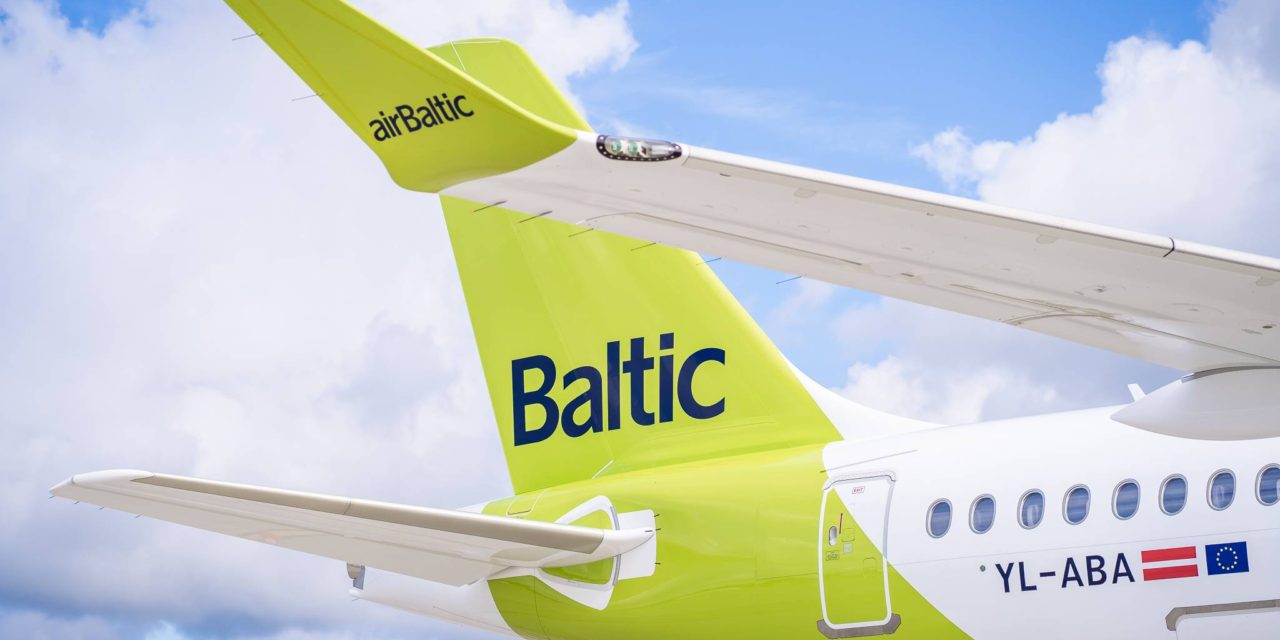
The Latvian carrier has secured €350 million in bankruptcy financing as it seeks to restructure a capital base strained by expensive debt, aircraft costs and years of rapid expansion. Flights will continue as normal.
RIGA – airBaltic has filed for Chapter 11 bankruptcy protection in the United States, turning to a court-supervised restructuring after mounting debt and liquidity pressures left one of Europe’s fastest-growing regional carriers in need of a fundamental financial reset.
The Latvian flag carrier and certain subsidiaries voluntarily initiated proceedings in the U.S. Bankruptcy Court for the Southern District of New York. The airline said its flights, reservations and customer services would continue normally during the process.
The filing does not amount to a shutdown of the airline. Chapter 11 allows companies to remain operational while renegotiating debt, leases and other contractual obligations under court protection.
What makes the airBaltic case significant, however, is the contrast between its operational growth and the increasingly difficult economics underneath it.
The airline generated record revenue of €779.3 million in 2025 and carried 5.2 million passengers on its own network. Including ACMI operations – flying aircraft, crews, maintenance and insurance on behalf of other airlines – passenger volumes reached 8.7 million. Yet airBaltic still recorded a net loss of €44.3 million.
The restructuring is designed to address that imbalance.
€350 million lifeline
airBaltic has secured a commitment for €350 million in debtor-in-possession, or DIP, financing, arranged by Strategic Value Partners and backed by Barclays, Hayfin Capital Management, Morgan Stanley, Oaktree Capital Management and Strategic Value Partners.
The facility carries an interest rate of SOFR plus 8 percentage points, which the airline currently estimates at roughly 12%.
That is expensive money.
At a simple 12% annualised rate, a fully drawn €350 million facility would imply approximately €42 million in annual interest expense, before fees and assuming rates remain around current levels.
For context, that figure is almost equivalent to airBaltic’s entire €44.3 million net loss in 2025.
The financing should therefore be understood primarily as a bridge through restructuring, rather than cheap capital intended to fund another cycle of rapid expansion.
airBaltic: the numbers behind the restructuring
| Metric | Latest relevant figure |
|---|---|
| 2025 revenue | €779.3m |
| 2025 net result | –€44.3m |
| 2025 adjusted EBITDAR | €143.9m |
| Adjusted EBITDAR margin | 18.5% |
| 2024 adjusted EBITDAR margin | 24.6% |
| Network passengers, 2025 | 5.2m |
| Total passengers incl. ACMI | 8.7m |
| Total flights, 2025 | 78,400 |
| ACMI flights, 2025 | 30,100 |
| Existing 2029 bond | €380m |
| Coupon on 2029 bond | 14.5% |
| New DIP commitment | €350m |
| Indicative DIP rate | SOFR + 8% |
| Target Chapter 11 exit | around June 2027 |
Source: airBaltic, Latvian Ministry of Transport and company disclosures. Calculations: Aviationlife.
Aviationlife analysis: Revenue was growing. The balance sheet was not healing fast enough.
The headline financial numbers reveal why simply looking at passenger growth gives an incomplete picture of airBaltic.
Revenue increased 4% in 2025 to €779.3 million, reaching a company record, while its net loss narrowed sharply from €118.2 million in 2024 to €44.3 million. Those are material improvements.
But the underlying operating picture was less straightforward.
Adjusted EBITDAR declined from €184.2 million to €143.9 million, while the margin fell from 24.6% to 18.5% – a deterioration of more than six percentage points despite record revenue.
In other words, airBaltic was selling more but extracting less operating return from each euro of revenue before aircraft rentals, depreciation, interest and tax.
The resulting net margin was approximately –5.7% in 2025, according to Aviationlife calculations based on reported revenue and net income.
That matters because an airline carrying expensive debt needs strong cash generation, not merely traffic growth.
The €380 million bond is central to the story
Before entering Chapter 11, airBaltic was already attempting to renegotiate the terms of its €380 million bonds due in 2029, which carry a coupon of 14.5%. Bondholders approved amendments in August that allowed interest payments due in August and November 2026 to be capitalised instead of paid in cash, while temporarily relaxing minimum-liquidity requirements.
A 14.5% coupon on €380 million translates into roughly €55.1 million of annual coupon interest, or about €13.8 million per quarter, before considering other debt and financing costs.
That single annual coupon is larger than airBaltic’s entire 2025 net loss.
It also represents roughly 7% of the airline’s 2025 annual revenue.
The size of that burden helps explain why strong passenger numbers and record revenue alone could not solve the carrier’s financial problem.
Just days before the Chapter 11 filing, Fitch Ratings estimated that airBaltic required approximately €156 million of short-term funding to maintain operations, while the airline was pursuing as much as €257 million in new super-senior financing. Fitch described the carrier’s alternatives as “quite limited” if stakeholders failed to approve the funding plan.
The Chapter 11 filing fundamentally changes that process by placing the restructuring under the supervision of a U.S. court and introducing a much larger €350 million DIP financing package.
A €730 million financing picture – but not simply €730 million of new debt
Another way of putting the scale into perspective is to compare airBaltic’s major financing instruments with the size of its business.
The €380 million 2029 bond is equivalent to approximately 49% of airBaltic’s 2025 revenue.
The new €350 million DIP commitment is equivalent to another 45%.
Together, their face values amount to about 94% of one year of airBaltic revenue.
That does not mean airBaltic is simply adding €350 million to its existing debt burden on a permanent basis. DIP financing is designed to support a company while it restructures and can ultimately form part of a broader refinancing or recapitalisation.
But the comparison illustrates the scale of the financial restructuring relative to the airline itself.
This is not a marginal balance-sheet adjustment.
It is a recapitalisation exercise.
The ACMI transformation
There is another important part of the airBaltic story: the company increasingly operates as two businesses at once.
One is the traditional Baltic network carrier centred on Riga.
The other is a large provider of aircraft capacity to other European airlines through ACMI contracts.
In 2025, airBaltic operated 30,100 ACMI flights out of 78,400 total flights, meaning ACMI accounted for about 38% of all flights operated, according to Aviationlife calculations based on company data. ACMI flying increased 15% year-on-year.
By the second quarter of 2026, that dependence had become even more pronounced.
Flightradar24 data showed that airBaltic recorded 19,547 ACMI flight hours in Q2 2026, making it the world’s largest ACMI airline by flight hours during the period.
Separate industry data indicate that approximately 44.4% of airBaltic’s total flight hours during the quarter were ACMI operations.
That evolution has helped airBaltic maximise the utilisation of its Airbus A220 fleet and diversify revenue away from the relatively small Baltic home markets.
It also explains why Lufthansa’s relationship with the carrier matters.
Lufthansa has more than a passive interest
Lufthansa Group invested €14 million in airBaltic through a transaction initially structured around a 10% interest, building on an existing wet-lease partnership between the two companies. Lufthansa has described airBaltic as a strategic partner for improving the flexibility and stability of its network.
That relationship is particularly important because airBaltic aircraft have operated extensively for Lufthansa Group airlines.
The investment itself is small relative to the size of Lufthansa Group. But airBaltic’s operational role is more significant than the nominal value of the equity investment suggests.
For Lufthansa, the Latvian airline provides something valuable: access to a relatively young, single-type A220 fleet and crews that can be deployed flexibly across the group’s network.
For airBaltic, Lufthansa provides scale, demand and a major European commercial counterparty.
The restructuring therefore has implications beyond Latvia.
The A220 strategy created both an advantage and an exposure
airBaltic’s single-fleet strategy has long been one of its defining features.
Operating exclusively Airbus A220-300 aircraft offers clear advantages: fleet commonality reduces complexity in pilot training, maintenance, scheduling and operations, while the A220 is particularly well suited to the relatively thin European routes that form much of airBaltic’s network.
But concentration also creates risk.
When Pratt & Whitney engine availability problems affected the A220 fleet, airBaltic had fewer alternatives within its own operation. Aircraft groundings forced the carrier to manage capacity shortages while continuing to carry financing and leasing costs.
The airline subsequently used externally wet-leased aircraft to maintain parts of its schedule, adding another layer of operating cost.
This is a classic airline economics problem: an aircraft can stop generating revenue when it is grounded, but many of the costs associated with owning or leasing it continue.
The result was pressure on an already leveraged capital structure.
The growth paradox
There is a broader lesson in airBaltic’s restructuring.
By conventional operational measures, this is not an airline whose customers disappeared.
It carried record passenger volumes.
Revenue reached record levels.
Its ACMI business expanded.
Its aircraft are in demand from some of Europe’s largest airline groups.
And airBaltic remains strategically important to the international connectivity of Latvia and the wider Baltic region.
Yet traffic growth does not automatically create financial sustainability.
Between 2024 and 2025, revenue rose while adjusted EBITDAR declined. The carrier remained loss-making and continued to face exceptionally expensive financing.
That distinction is important.
airBaltic’s immediate problem is not primarily a lack of passengers. It is the cost of the capital structure supporting the airline.
Chapter 11 gives management the legal framework to address precisely that problem.
What Chapter 11 changes
Under Chapter 11, airBaltic can continue operating while seeking agreements with bondholders, lenders, aircraft lessors and other creditors.
It also gives the company protection from certain creditor actions and greater flexibility to restructure financial and contractual commitments.
For an airline, aircraft leases are especially important because fleet costs represent long-term fixed commitments that cannot always be adjusted quickly when market conditions deteriorate.
The process has precedents in aviation.
United Airlines, Delta Air Lines and American Airlines all used Chapter 11 during earlier restructuring cycles in the United States, while SAS used the same framework more recently as part of its own financial reorganisation.
Chapter 11, therefore, should not be confused with liquidation.
The relevant question is not whether airBaltic is flying today. It is.
The question is what airBaltic will look like when it emerges.
Passengers remain largely insulated – for now
For customers, the immediate consequences are limited.
airBaltic says scheduled flights will continue, existing tickets and reservations remain valid and passengers can continue purchasing tickets.
Refunds, vouchers, gift cards and credits associated with service or baggage claims will continue to be processed under existing policies.
The existing Management Board and Supervisory Board also remain in place.
That continuity is a fundamental feature of the Chapter 11 process: the airline needs to preserve bookings, customer confidence and operating revenue while financial negotiations take place in the background.
The state remains exposed
airBaltic is not an ordinary privately owned European airline.
The Latvian state controls 88.37% of voting rights, while Deutsche Lufthansa AG holds 10%, with private investors accounting for the remainder.
That makes the restructuring economically and politically significant.
airBaltic functions as a core piece of Latvia’s aviation infrastructure, providing connectivity that would be difficult for the country’s relatively small home market to replicate through purely point-to-point foreign carriers.
The state therefore faces a familiar flag-carrier dilemma: maintaining strategically valuable connectivity while avoiding an open-ended requirement for public capital.
Chapter 11 offers a mechanism for shifting some of that adjustment onto the broader capital structure – including lenders, bondholders, lessors and other creditors – rather than treating new shareholder funding as the only solution.
What to watch next
The €350 million DIP package solves the most urgent liquidity question, subject to court approval.
It does not, by itself, solve the underlying economics.
The successful restructuring will depend on how much existing debt can be reduced or repriced, what concessions can be negotiated with aircraft lessors, how much new equity eventually enters the company and whether airBaltic can produce sustainable free cash flow after restructuring.
The future balance between its own Baltic network and the growing ACMI business will be equally important.
airBaltic expects the Chapter 11 process to be completed around June 2027.
If successful, the company could emerge with many of the same operational assets – its A220 fleet, Baltic network, Riga hub and major European ACMI relationships – but with a radically different balance sheet.
That is ultimately the logic behind the filing.
airBaltic does not need Chapter 11 because nobody wants to fly with it.
It needs Chapter 11 because the financing structure behind those flights became too expensive to sustain.
Analysis by Aviationlife.gr based on airBaltic financial disclosures, Latvian Ministry of Transport data, Lufthansa Group disclosures, Fitch assessments and publicly available aviation market data. Calculations are Aviationlife estimates and may differ from company-defined financial measures.