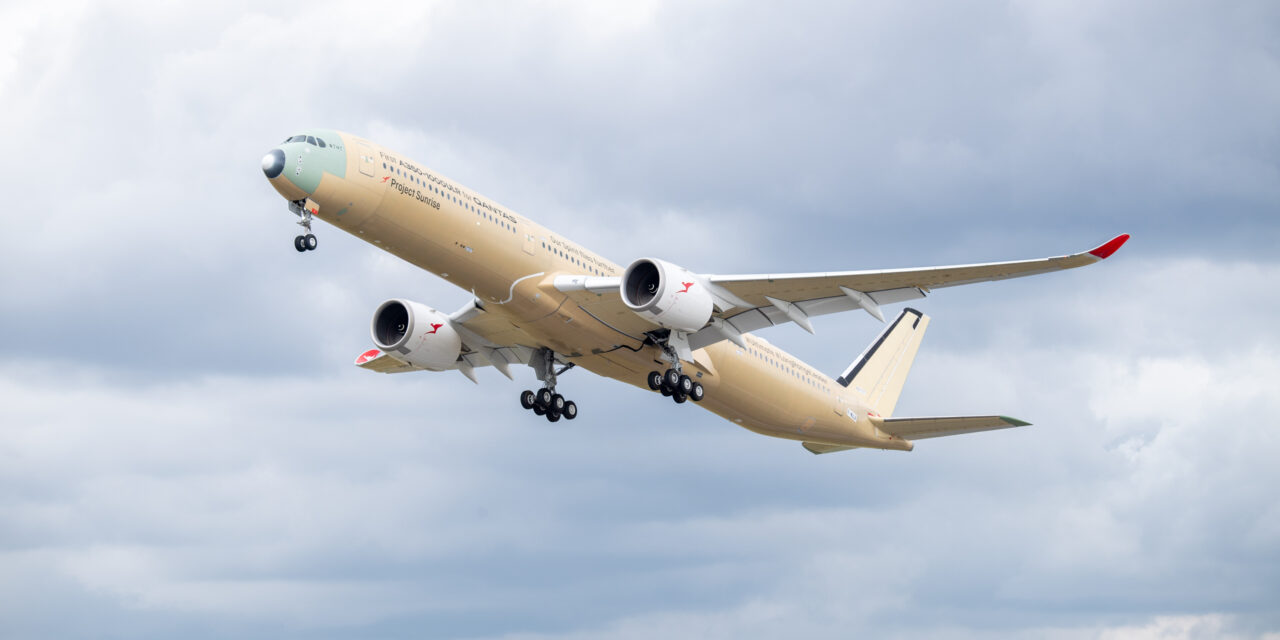
The Airbus A350-1000ULR (Ultra Long Range) has successfully completed its first non-stop test flight from Europe to Australia, marking a major milestone in the certification programme for Qantas’ ambitious Project Sunrise.
Departing from Airbus’ headquarters in Toulouse, France, the specially modified aircraft (test registration F-WULR) landed in Melbourne after a 19-hour, 13-minute journey covering approximately 17,000 km. The flight represented the first time the A350-1000ULR has reached Australian soil and served as one of the most demanding phases of Airbus’ certification campaign.
A new benchmark for ultra-long-haul aviation
The aircraft has been specifically developed for Qantas’ Project Sunrise, which aims to connect Australia’s east coast directly with destinations such as London and New York without intermediate stops.
To achieve these missions, Airbus has introduced several modifications compared with the standard A350-1000, including:
- an additional 20,000-litre rear centre fuel tank,
- a maximum endurance of up to 22 hours,
- a reduced-capacity premium-focused cabin with 238 seats,
- dedicated crew-rest facilities and passenger wellbeing areas designed to minimise the effects of ultra-long-haul travel.
Extensive systems validation
Unlike a commercial delivery flight, the mission was conducted by four Airbus test pilots and five flight-test engineers, who monitored thousands of aircraft parameters throughout the journey.
The Melbourne mission forms part of an approximately 80-hour certification campaign, during which Airbus is validating aircraft systems, fuel performance, aerodynamics, environmental controls and operational procedures under extreme endurance conditions before certification by European aviation authorities.
Commercial service from 2027
Qantas has ordered 12 Airbus A350-1000ULR aircraft. Following production delays, the first aircraft – named Vega – is expected to be delivered in April 2027, with commercial Sydney–London nonstop operations planned to commence in October 2027, followed by Sydney–New York services.
The successful Melbourne test flight demonstrates that the aircraft is progressing as planned toward entry into service and represents one of the most significant developments in long-haul commercial aviation since the introduction of the Boeing 787 and Airbus A350 families.