
Revisiting liberalization, competitiveness, and the role of state support in a transforming global market.
Analysis by Dimitris Zopounidis, PhD Candidate (Data Science, Business Analytics, Aviation Industry), DS Lab
Founder of Aviationlife.gr and of the Crete Aviation Observatory
Inspired by the recent article published in (Les Echos – La grande offensive des patrons d’Air France–KLM et Lufthansa pour obtenir des règles du jeu équitables) this analysis examines the broader strategic implications of the joint statement by Benjamin Smith (Air France–KLM) and Carsten Spohr (Lufthansa). Their intervention marks a significant development for the European aviation industry, reminding policymakers that Europe once again stands at a crossroads where its strategic autonomy is being tested.
This debate is not new; it has a deep institutional history. In 2016, with the dissolution of the Association of European Airlines (AEA), a more liberal approach prevailed among several major European carriers that sought closer partnerships with airlines from the Gulf and the Middle East. One of the main reasons for AEA’s collapse was precisely the refusal of Air France and Lufthansa to follow this path and adopt a strategy of convergence with the Gulf carriers.
In the following phase, the idea of “win–win” synergies and market liberalization gained momentum, leading to the creation of Airlines for Europe (A4E), a more flexible framework that embraced cooperation with non-EU carriers and welcomed the participation of low-cost airlines, something unimaginable under the AEA (1952–2016). That decision seemed progressive at the time, yet today the European sector is facing the long-term consequences of that strategic shift.
Over the past two decades, Qatar Airways has expanded by 1005% and Turkish Airlines by 756%, while Europe’s major airline groups have seen marginal growth (Air France +14%, Lufthansa +16%). This imbalance did not arise naturally from the market but from asymmetric competitive conditions, including unchecked state support, preferential regulatory frameworks, and national strategies that treat aviation as a pillar of sovereign interest.
The impact on Europe is now visible:
- Reduction of direct intra-European connections
- Passenger traffic leakage toward non-EU hubs
- Loss of jobs and technical know-how
- Diminished European control over the aviation value chain
The European Commission is now confronted with a crucial dilemma: how to safeguard a sector of strategic importance without abandoning the principle of open competition. The COVID-19 crisis served as a reminder of the need for resilience and autonomy within European transport networks, as over-reliance on external hubs proved vulnerable to disruption.
At the same time, the debate over strategic autonomy has become inseparable from the green transition. Sustainable aviation fuels (SAF), decarbonization, and new energy infrastructures require European leadership. Control over connectivity also means control over the path toward sustainable mobility.
In essence, the industry that once believed in liberalization through partnerships is now returning to the demand for fair and balanced competition. Not to close the market, but to ensure that Europe does not become a mere feeder for third-country hubs.
The joint stance of Air France–KLM and Lufthansa’s leadership is therefore not a passing statement. It marks the beginning of a broader European conversation about who will control (and under what terms) the future of aviation industry on the continent. A conversation that is no longer only economic, but deeply political and strategic.
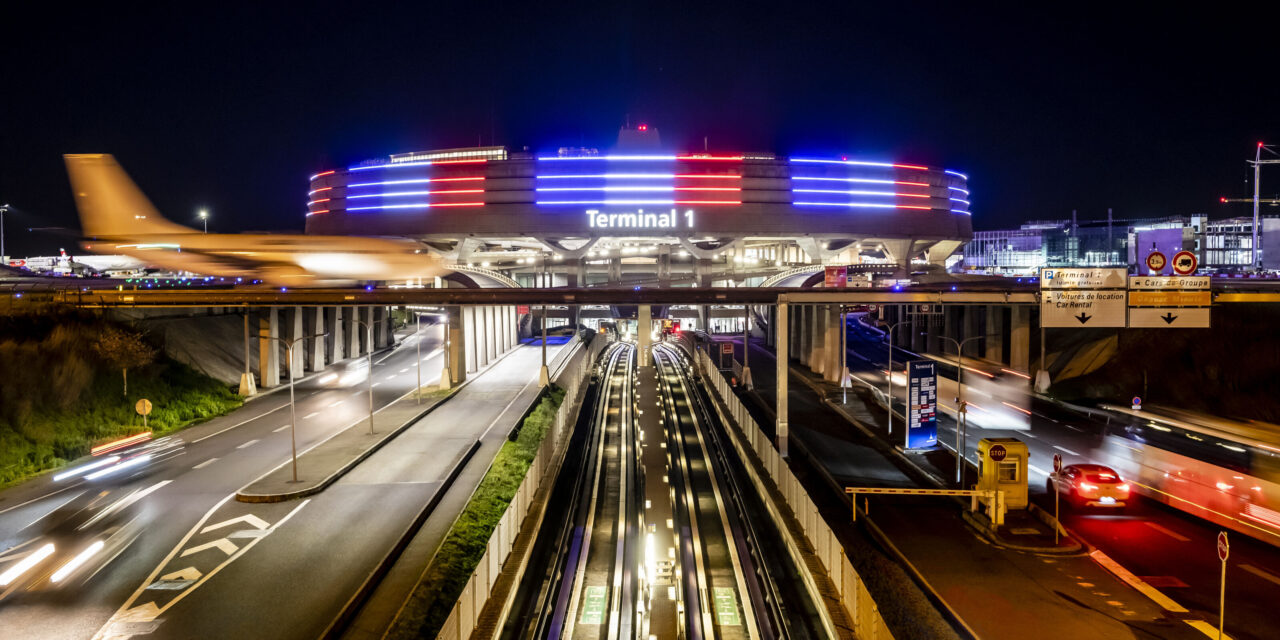
© Groupe ADP / Ref. ADP-P-2020-51387 – Night view of Terminal 1, Paris-Charles de Gaulle.


