
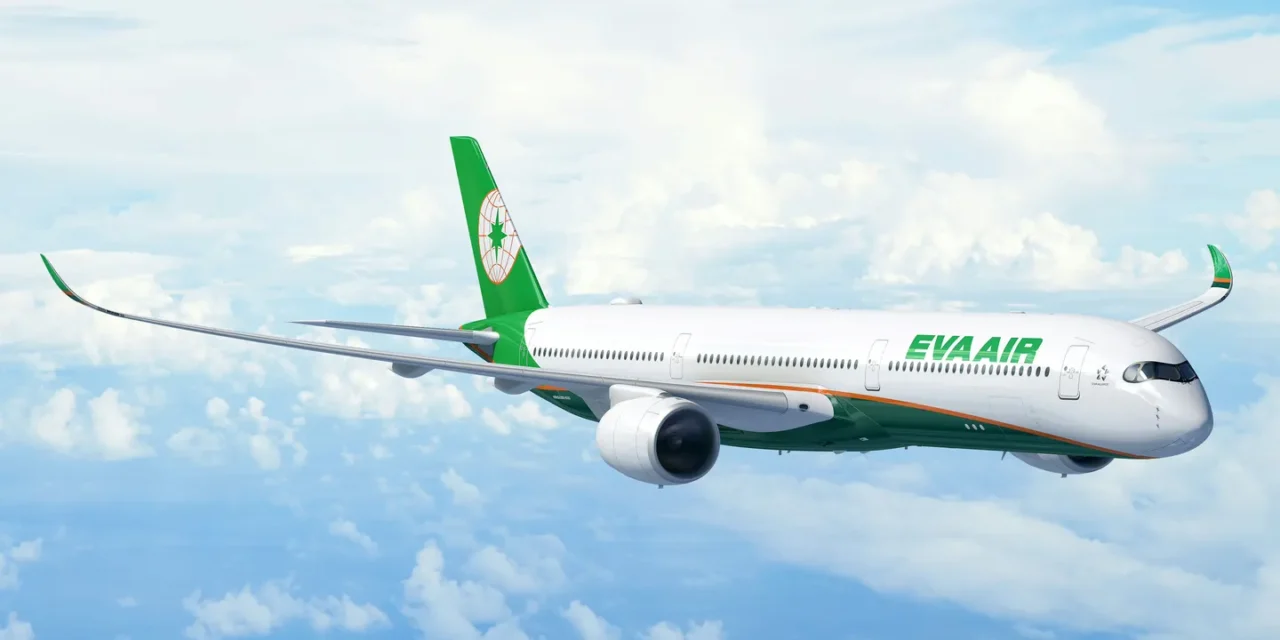
EVA Air is set to launch nonstop service between Taipei (TPE) and Washington, D.C. (Washington Dulles, IAD) on 26 June 2026, operating four weekly frequencies.
The schedule, as published by the airline, is structured around evening departures from Taipei and early-morning returns from Washington. BR04 will operate Monday, Wednesday, Friday, Saturday, departing 19:30 and arriving 22:30 local time. The return BR03 will operate Tuesday, Thursday, Saturday, Sunday, departing 01:50 and arriving 05:45+1 in Taipei.
Operationally, this is more than a new dot on the map. EVA Air frames North America as a key strategic market, and Washington, D.C. is a high-value addition. It is framed as an origin-and-destination market with steady premium demand drivers (government, institutions, corporates, academia) and strong year-round travel fundamentals. The airline explicitly positions the route as an East Coast reinforcement following its Dallas–Fort Worth launch last year, which made EVA Air the only Asian carrier serving two Texas destinations.
The route will be operated with the Boeing 787-9, configured in three classes: Royal Laurel Class, Premium Economy, and Economy. This detail matters because EVA Air is not simply adding capacity; it is adding capacity with a clear revenue structure. Premium Economy, especially in long-haul transpacific markets, functions as a yield-management instrument: it captures travellers who will not pay business-class fares but are willing to pay a meaningful premium over economy for space, comfort, and service differentiation. In network terms, that strengthens unit revenue without relying solely on volume growth.
At the network level, EVA Air states that the Washington, D.C. launch expands its North American footprint to 10 gateways and increases total North America flying to 98 weekly flights. The carrier also notes that two of its North American gateways will feature its new fourth-generation Premium Economy product.
For Washington Dulles, the route is equally strategic. The Metropolitan Washington Airports Authority highlights that the nonstop link will reduce travel times and improve connectivity via EVA Air’s hub at Taiwan Taoyuan International Airport, enabling onward access across Asia.
From a data-driven perspective, the launch is best interpreted as a targeted capacity addition on a market with credible premium upside and strong hub connectivity logic. In a long-haul environment where profitability is increasingly determined by cabin mix and network quality, not just load factors, EVA Air’s TPE–IAD move reads as a disciplined, high-signal expansion.


