AVIATIONLIFE.GR | AIRPORT ANALYSIS
Zurich Airport:
The Quiet Discipline of a Coherent Hub
Zurich does not try to impress, and that is the source of its strength. An analysis of how traffic, network, rail, design and regulation fit together at ZRH.
By Dimitris Zopounidis
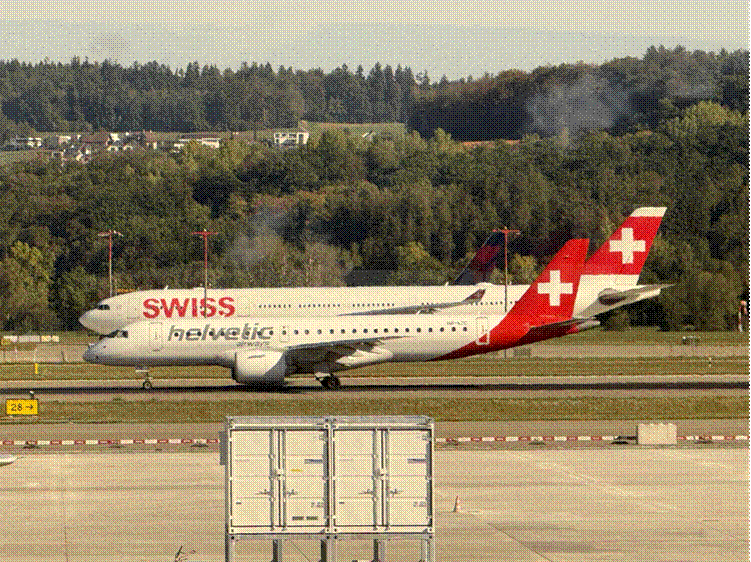
A Helvetic Embraer alongside a SWISS widebody, with a Delta tail behind. Regional feed and long-haul capacity of the same hub in a single frame. Photo: Dimitris Zopounidis
Ten minutes, one system
The first thing I noticed while taxiing in was not the terminal. It was a row of SWISS A340s parked under four tower cranes, with a fifth construction site visible behind them. Zurich was building, and building at scale. Yet nothing on the apron looked improvised. Barriers were aligned and taxiway signs were legible. Ground vehicles moved like trains running to a timetable.
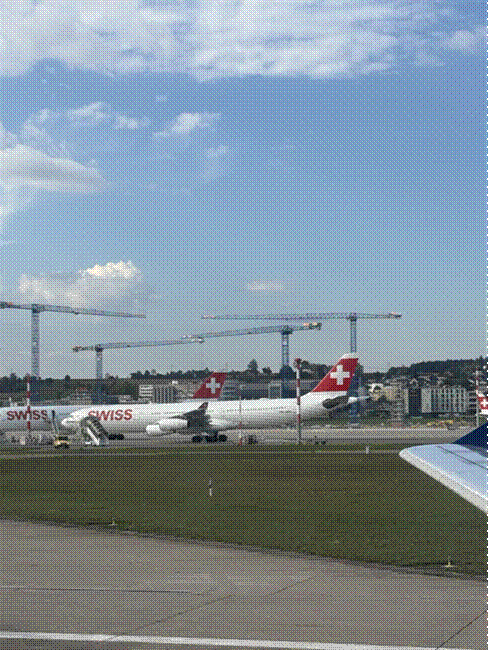
SWISS A340s under four tower cranes on arrival. Zurich is rebuilding major infrastructure while operating at record traffic. Photo: Dimitris Zopounidis
A few hours later, airside, a small square of chocolate sat on the saucer of an espresso. It was printed with the words “Thank you for flying SWISS”. It is a trivial detail. But it belongs to the same logic as the cranes, the signage and the train station beneath the terminal: a consistent idea of how things should be done, repeated at every scale.
What struck me most was not a single architectural gesture. It was consistency. Zurich gives the impression that very little has been left to chance. The question this article asks is why. Why does an airport handling more than 32 million passengers a year, with a constrained runway system, a politically sensitive night regime and a construction programme running for years, feel so unusually coherent? The answer, I will argue, lies less in architecture than in the way several systems have been designed to work as one.

An espresso in the SWISS lounge. Consistency at Zurich extends to details passengers barely notice. Photo: Dimitris Zopounidis
The numbers behind the calm
Zurich’s traffic history over the past decade is a story of growth, collapse, and recovery that has now become growth again.
| Year | Passengers (millions) | Note |
| 2016 | 27.7 | |
| 2018 | 31.1 | |
| 2019 | 31.5 | pre-pandemic benchmark |
| 2020 | 8.3 | |
| 2021 | 10.2 | |
| 2022 | 22.6 | 72% of 2019 |
| 2023 | 28.9 | 91.7% of 2019 |
| 2024 | 31.2 | 99% of 2019 |
| 2025 | 32.6 | 103.4% of 2019, all-time record |
| H1 2026 | 15.8 | partial year, +6% |
Source: Flughafen Zürich AG annual reports and traffic releases. Swiss national statistics use slightly different definitions, so official airport figures are used throughout.
In 2019, the pre-pandemic benchmark, the airport set a record of 31,507,692 passengers. Traffic fell to 8.3 million in 2020. In 2025, 32.6 million passengers passed through Zurich, 4.5% more than in 2024 and 103.4% of the 2019 level. The first half of 2026 brought 15,793,939 passengers, up 6% year on year and the strongest first half in the airport’s history.
The more interesting figure is not passengers. It is movements. In 2025 the airport recorded 270,116 aircraft movements, 3.5% more than in 2024 but still 1.9% below 2019. Average seat load factor rose to 79.8%, 1.5 percentage points above 2019, which the airport attributes to larger aircraft and fuller cabins.
From the published totals, this gives roughly 121 passengers per movement in 2025 against roughly 114 in 2019, calculated across all movements including general aviation. Zurich now carries about 5% more passengers per take-off or landing than before the pandemic. For an airport whose operating hours and runway use are tightly regulated, this is not a side statistic. It is the strategy. When you cannot easily add slots, you add people per slot.
The commercial side follows the same discipline. In the first half of 2026, revenue reached CHF 673.6 million (+5%) and EBITDA CHF 374.2 million (+4%). The consolidated result of CHF 163.7 million was the best half-year in the company’s history. This implies an EBITDA margin of about 55.6%. The revenue mix is almost evenly balanced: CHF 345.2 million from aviation and CHF 328.4 million from non-aviation. Roughly 49 francs out of every 100 therefore come from retail, parking, real estate and services rather than from airport charges.
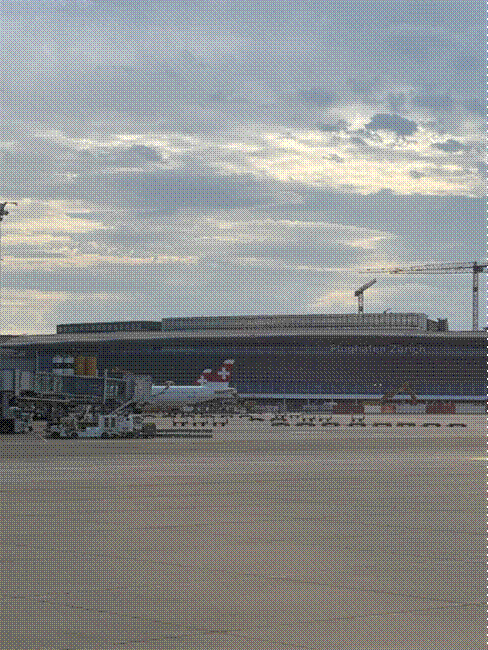
The main terminal facade: a long, low glass front with plain lettering and no signature architecture. Photo: Dimitris Zopounidis
Zurich Airport at a glance
| Indicator | Value | Period |
| Passengers | 32.6 million | 2025 |
| Aircraft movements | 270,116 | 2025 |
| Seat load factor | 79.8% | 2025 |
| Cargo | 440,930 t | 2025 |
| Transfer share | 29% | 2025 |
| Airlines / destinations | 67 / 212 | Summer timetable 2026 |
| Runways | 16/34 (3,700 m), 14/32 (3,300 m), 10/28 (2,500 m) | current |
| Operating hours | 06:00–23:30 (23:00–23:30 for delays only) | current |
| Public transport share, all users | 46% | 2024 survey |
| Rail to Zurich HB | ~13 trains/hour, 9–13 minutes | timetable |
Three airports, one size
Benchmarking Zurich against Frankfurt or Amsterdam would be misleading, because those airports operate at a different scale. The relevant peers are airports of similar size that also serve as hubs for a network carrier. In 2025, Europe produced an unusual natural experiment: three such airports finished the year with almost exactly the same traffic.
Vienna handled 32,559,115 passengers in 2025 (+2.6%) and serves as the hub of Austrian Airlines, which has about a 46% share of passengers there. Copenhagen recorded 32.4 million passengers, a new record, with 62 airlines and 367 routes operated during the year. Almost one in four passengers there is transferring.
| Zurich (ZRH) | Vienna (VIE) | Copenhagen (CPH) | |
| Passengers 2025 | 32.6 m | 32.6 m | 32.4 m |
| Hub carrier | SWISS (Lufthansa Group) | Austrian (Lufthansa Group) | SAS |
| Transfer share | 29% | – | ~25% (“almost one in four”) |
| Hub carrier share of passengers | SWISS 51.2% (2023) | Austrian ~46% | – |
| Network indicator | 212 destinations, 67 airlines (S26) | – | 367 routes, 62 airlines (2025) |
Zurich reports destinations in a timetable season, while Copenhagen reports routes operated over a full year. These are not directly comparable and should not be ranked against each other. Cells marked “–”: no comparable primary figure available.
The comparison matters because it removes scale as an explanation. Zurich does not feel different because it is larger or smaller than its peers. With the same passenger volume as Vienna and Copenhagen, it combines a higher transfer share with a rail station inside the terminal complex and a city centre about ten minutes away. Vienna airport lies about 18 km from the city. The differences are structural rather than volumetric.
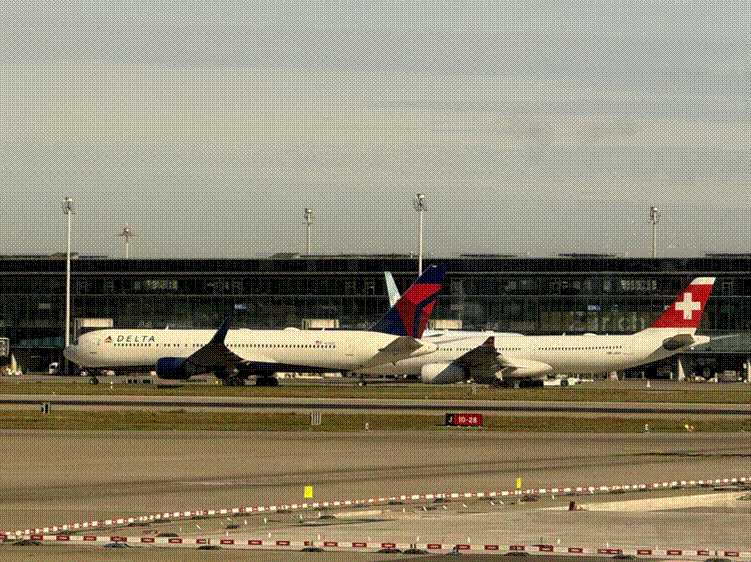
A Delta 767 and a SWISS A330 at Dock E. Zurich and Vienna had the same passenger volume in 2025, but Zurich’s transfer share is higher. Photo: Dimitris Zopounidis
The logic of the hub
Zurich is first the SWISS hub. In 2023, SWISS accounted for 51.2% of passengers and Edelweiss for 10%. Lufthansa Group airlines together held a 67% share and carried about 93% of transfer passengers at Zurich. In practice, almost the entire transfer function of the airport is a Lufthansa Group function.
Transfer traffic accounted for 29% of passengers in 2025. Transfer volumes were almost identical to 2024, and the transfer market was only 1% above 2019, against 4% growth in the local market. In August 2026, 1,016,420 passengers transferred at Zurich, 30.6% of the monthly total.
The two flows are visible from the windows of the A gates. Across runway 10/28, at the midfield Dock E, long-haul aircraft were parked side by side: a Delta 767, a United 787, an Air Canada 777, Singapore and Qatar widebodies, an Edelweiss A340, and SWISS A330s and A340s. On the near side stood the short-haul feed: SWISS A220s and A320-family aircraft, a Lufthansa A319 in Star Alliance livery, an Austrian A320, and Helvetic Embraers. The departures board in the lounge made the alliance logic explicit. Next to almost every SWISS flight, a “Partner” column listed codeshares with United, Air Canada, Air India, Aegean and others. At 08:40, the same screen showed departures to both Athens and Thessaloniki.
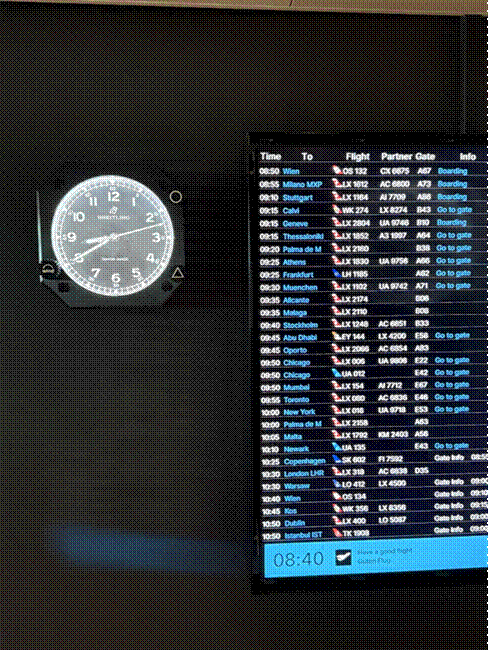
The departures board at 08:40. The “Partner” column shows the codeshare structure behind the SWISS network, including flights to Athens and Thessaloniki. Photo: Dimitris Zopounidis
The hub is concentrated, and that concentration produces the clarity passengers feel. One dominant group, one main alliance and one coordinated schedule mean that the airport’s physical layout and the airline’s network logic are largely aligned. As discussed below, this alignment is also a dependency.
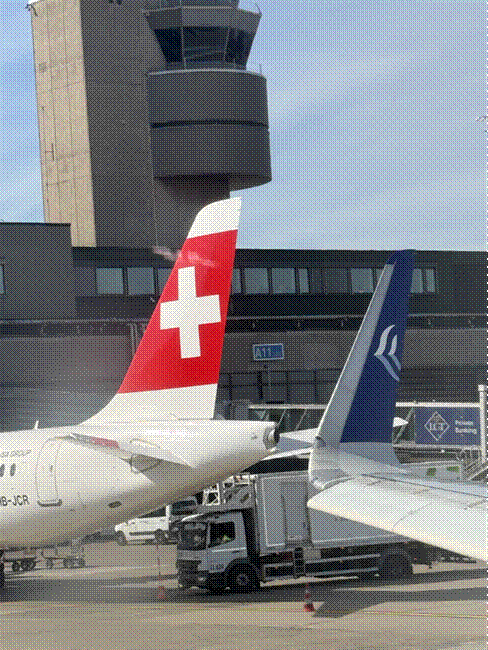
A SWISS tail and an Aegean tail in front of the control tower at gate A11. The hub carrier, a Star Alliance partner and a tower that is due to be replaced, in one frame. Photo: Dimitris Zopounidis
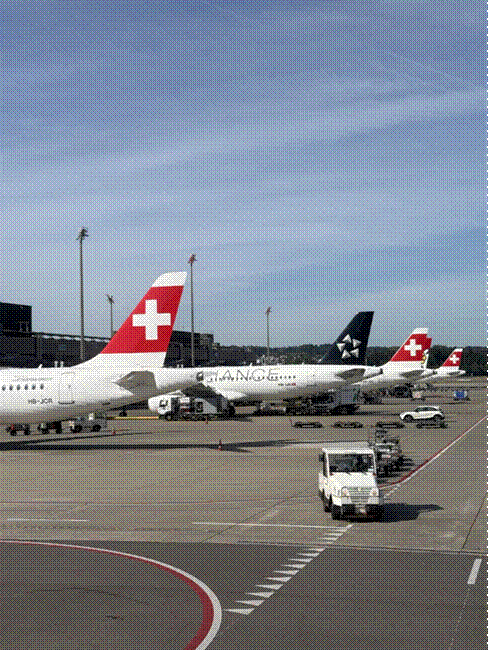
SWISS, Star Alliance-liveried and further tails along the A gates: the short-haul feed for the long-haul bank. Photo: Dimitris Zopounidis
Connectivity in layers
Connectivity at Zurich operates on several levels at once.
European connectivity. Europe remains the core market, with 75% of passengers in 2025. It grew 4% year on year and was 5% above 2019, driven by southern leisure destinations in Spain, Italy, Turkey and Portugal.
Long-haul connectivity. The intercontinental segment carried one quarter of passengers in 2025 and grew 6% year on year, although it was still half a percentage point short of full recovery to 2019 levels. North America was around 13% above pre-pandemic levels, Africa grew fastest at 18%, and the Far East consolidated its position as the third-largest region. For a country of nine million people, this is an unusually broad intercontinental offer.
Network breadth. In the summer 2026 timetable, 67 airlines fly to 212 destinations from Zurich, slightly more than in the previous summer.
| Network snapshot | Value |
| Europe, share of passengers (2025) | 75% |
| Intercontinental, share of passengers (2025) | 25% |
| North America vs 2019 | ~+13% |
| Fastest-growing region (2025) | Africa, +18% |
| Lufthansa Group share of passengers (2023) | 67% |
| Lufthansa Group share of transfer passengers (2023) | ~93% |
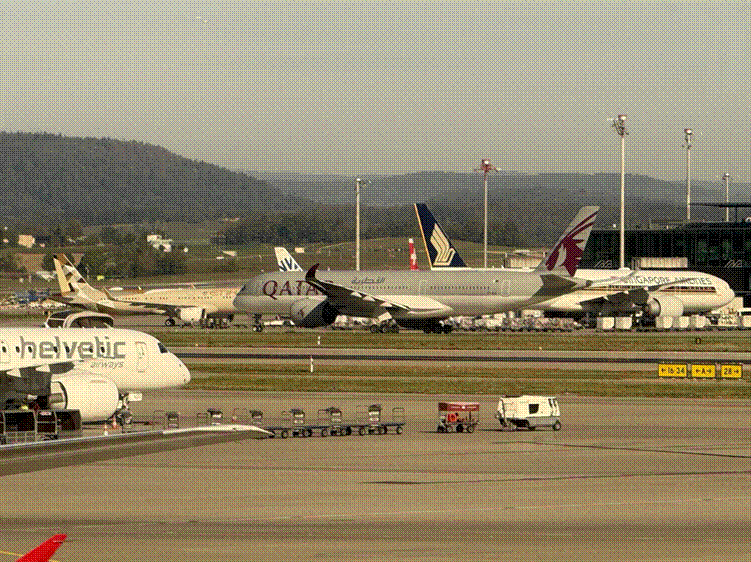
Qatar A350, Singapore 777 and Etihad aircraft at the midfield dock. Intercontinental traffic accounts for a quarter of Zurich’s passengers. Photo: Dimitris Zopounidis
Rail: where the airport becomes part of Switzerland
The strongest feature of ZRH may ultimately be its connectivity beyond aviation.
The station sits beneath the airport complex. It is served by around 300 trains a day, a mix of long-distance and suburban services. For most of the day, about 13 trains per hour run to Zurich HB, with journey times of 9 to 13 minutes. The IC 1 line links the airport via Zurich directly to Geneva Airport in one direction and to St. Gallen in the other. In other words, Switzerland’s two largest airports are on the same intercity axis. Tram line 10 offers a slower, stop-by-stop alternative into the city.
The results are measurable. In the 2024 survey, 46% of all passengers, employees and visitors travelled to the airport by public transport, the highest share ever recorded. Among departing passengers the figure was 58%, and among visitors 63%. The airport also counted about 30 million public transport users in 2024, around 20% of them purely connecting between trains and buses. This is almost as many as its 31.2 million air passengers. Zurich Airport is therefore also one of Switzerland’s most important ground transport interchanges, regardless of aviation.
This is the core of the coherence argument. At most airports, the train is a way out. At Zurich, the train is a continuation of the same system: the same timetable culture, the same reliability expectation and the same design language. The airport does not end at the terminal door. It is one node in a national network.
Elegance as restraint
If Zurich is elegant, it is not because of spectacle. The main terminal facade is a long, low curve of glass and horizontal louvres with “Flughafen Zürich” written in plain white letters. There is no landmark roof and no signature form. The building presents itself as infrastructure, not as a monument.
Quality is communicated through details that are easy to miss. In the SWISS lounge, the welcome wall reads “Welcome, Willkommen, Bienvenue, Benvenuti, Bainvegni”. The last word is Romansh, the fourth national language, spoken by a small minority. Including it costs nothing and says a great deal about how the country represents itself. The materials are light oak, vertical timber slats and dark leather. In the work booths, slated screens filter daylight into striped shadows across the desk. Power outlets are integrated into furniture and labelled. The departures board hangs next to an analogue clock. None of this is luxurious. It is careful.
That same consistency extends into the digital passenger journey. Zurich Airport offers direct assistance through messaging channels such as WhatsApp and Messenger, allowing passengers to ask practical questions while moving through the terminal, from locating a gate to finding a particular service or facility. It is a small feature, but an unusually telling one: information is not treated as something passengers should have to search for, but as a service that follows them through the airport.
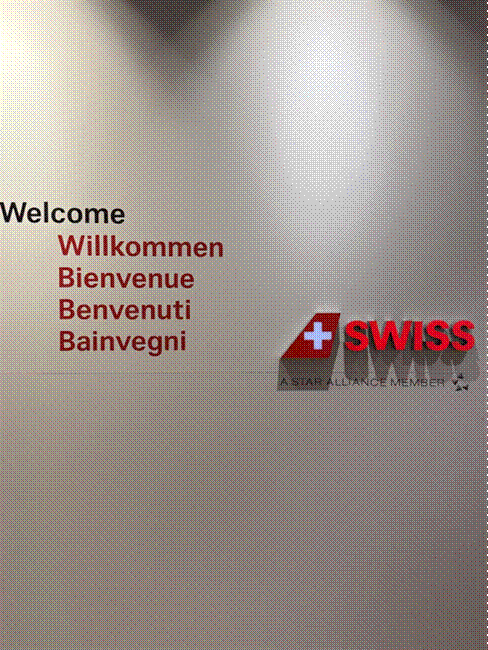
The SWISS lounge welcome wall in five languages. “Bainvegni” is Romansh, the fourth national language. Photo: Dimitris Zopounidis
The same restraint extends to the apron. Taxiway signage (“16-34”, “A”, “28”) is clean and easy to read in photographs taken from inside the terminal. Even the corridor sign that welcomes arriving passengers to Zurich as the “Home of Edelweiss” is understated: dark letters set into a textured wall rather than a light box.
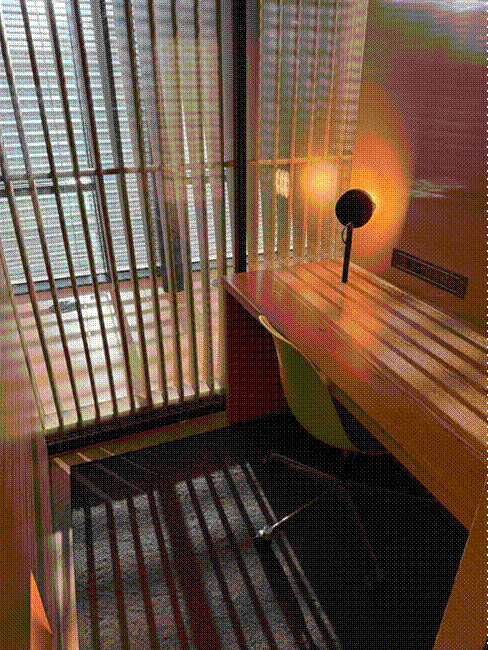
A lounge work booth. Oak slats filter the daylight; outlets are built into the furniture. Photo: Dimitris Zopounidis
This is, I think, what people mean when they describe Zurich as “elegant”. Elegance here is not added on top of the airport. It is the absence of anything unnecessary.
Under the apron lights: an airport with constraints
The aesthetic calm should not obscure the fact that Zurich operates within some of the tightest constraints of any major European hub.
The runway system has worked in its current form since 1 January 1976. There are three runways: 16/34 at 3,700 m, 14/32 at 3,300 m and 10/28 at 2,500 m. Two of them, 16/34 and 10/28, intersect. The “J 10-28” holding sign visible between the A gates and Dock E is a small reminder of how closely these surfaces interact.
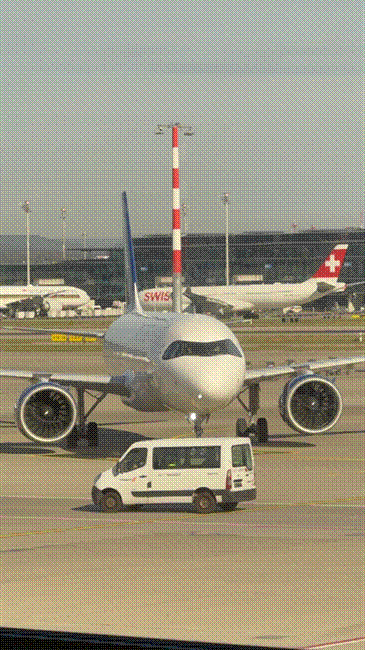
An Aegean A320neo taxiing past the “16-34 / A / 28” signs. The intersecting runway system is the airport’s main structural constraint. Photo: Dimitris Zopounidis
Airspace is the second constraint. Under the German implementing regulation (DVO), aircraft approaching Zurich may use German airspace below flight level 120 only during certain time windows. Because approaches to runways 14 and 16 come from the north over Germany, Zurich must change its operating concept depending on the time of day. Early in the morning, it uses southern approaches on runway 34. In the evening, from 21:00 on weekdays, aircraft arriving from the east must land on runway 28. When the “Bise”, a north-easterly wind, blows, the southern approach on runway 34 is used in the evening as well, to avoid tailwind on the eastern approach.
The third constraint is time. The airport is open from 06:00 to 23:30, and the last half hour, 23:00–23:30, is reserved for delayed flights. During the night curfew, all take-offs and landings require a special permit. In the first half of 2026, the Zurich Cantonal Council rejected the night-time curfew initiative and confirmed the existing operating hours. The National Council also supported legal protection of the operating hours of national airports in the revision of the Federal Aviation Act.
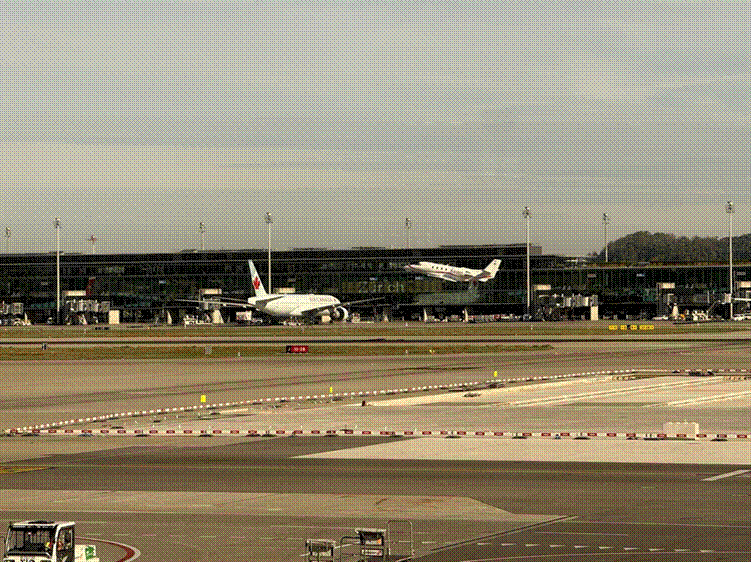
A business jet departing over the midfield dock, with an Air Canada 777 at the gate and the “J 10-28” holding sign in the foreground. Photo: Dimitris Zopounidis
Seen this way, the efficiency figures earlier in this article become easier to understand. Zurich’s high passengers-per-movement ratio is not just commercial optimisation. It is how a constrained airport grows.
Building while flying
The cranes on the skyline are part of the largest investment programme in the airport’s recent history. The Zurich Airport Group invested CHF 716 million in 2025, of which more than CHF 503 million was at the Zurich site. The largest single project is the replacement of Dock A, including the control tower and the dock base. Other projects include the refurbishment of the baggage sorting system, the redevelopment of landside passenger areas and a new cargo building.
The new Dock A is due by 2033 and will be LEED-certified. Its load-bearing structure will be largely timber, and its outer shell will be extensively covered with photovoltaics. The redeveloped landside passenger zones will open in stages from autumn 2027. Automation is also advancing: in September 2026, the airport reported that automated shuttle buses now operate without a safety driver on board.
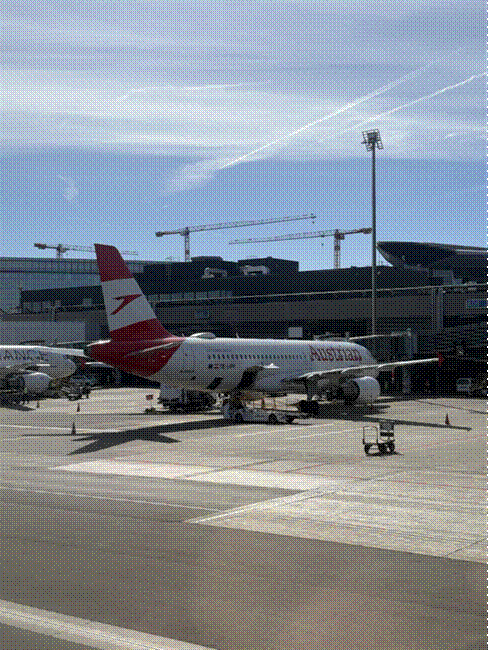
An Austrian A320 at the A gates, with cranes in the background. Dock A will be replaced by a timber-framed, LEED-certified building by 2033. Photo: Dimitris Zopounidis
The runway project is the most important operationally. In March 2024, Zurich voters approved the extension of runways 28 and 32 with about 62% in favour. Runway 28 will be extended by 400 m to the west, to 2,900 m, and runway 32 by 280 m to the north, to 3,580 m. The planning approval documents were open for public review from 1 to 30 June 2026. Construction is not expected to start before 2030, and the extension of runway 28 alone is expected to take seven to eight years including preparatory work.
The purpose is safety and stability, not capacity. Today, heavy long-haul aircraft at Dock E cannot use the shorter runway 32 and must taxi to runway 34, crossing runway 28 twice. The extension will allow practically all heavy long-haul aircraft to depart from runway 32, eliminating these crossings and improving punctuality. The Swiss regulator says explicitly that the project will not change the overall volume of air traffic at Zurich.
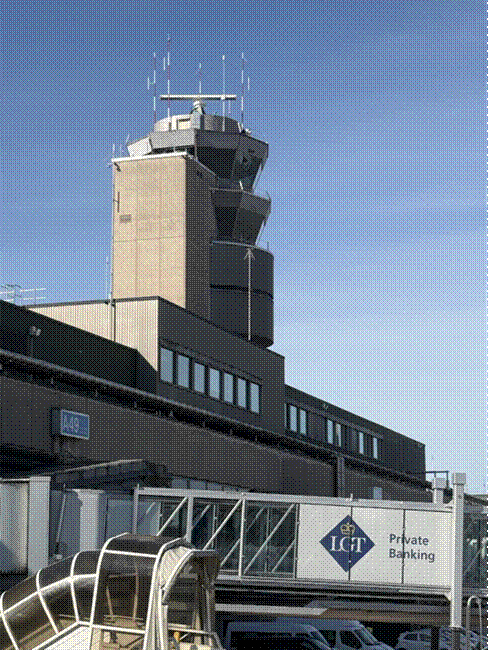
The current control tower above the A gates. It will be replaced together with Dock A. Photo: Dimitris Zopounidis
On climate, the airport’s target is net zero for its own emissions (Scopes 1 and 2) at all sites by 2040, without purchasing offset certificates. The first interim target at the Zurich site, reducing annual emissions to 30,000 tonnes from 2020, has been reached. The airport is accredited at Level 4 “Transition” of Airport Carbon Accreditation.
Where Zurich is less perfect
A coherent system is not a flawless one. Several weaknesses are visible in the data and on the apron.
The runway geometry remains a structural compromise. The extensions respond to a 2012 safety review that identified around 30 improvement measures. Until construction is completed, which in the case of runway 28 will take most of the next decade, Zurich will continue to operate with intersecting runways and crossings at peak times.
Operations depend on foreign airspace rules. The DVO restrictions mean that Zurich’s operating concept is partly determined across the border. The southern approach on runway 34 brings aircraft over densely populated areas in the morning. To limit disturbance, Flughafen Zürich AG equips bedrooms in affected municipalities with automatic window closers or sound-damping ventilation. Noise is not a peripheral issue in Zurich. It shapes politics, charges and runway use.
Not every passenger gets the airport shown in the photographs. Helvetic Embraers and a Croatia Airlines Q400 were parked at remote stands, with mobile stairs, baggage carts and an apron bus. For passengers on these flights, the boarding experience is a bus and a staircase, not a jet bridge with a view.
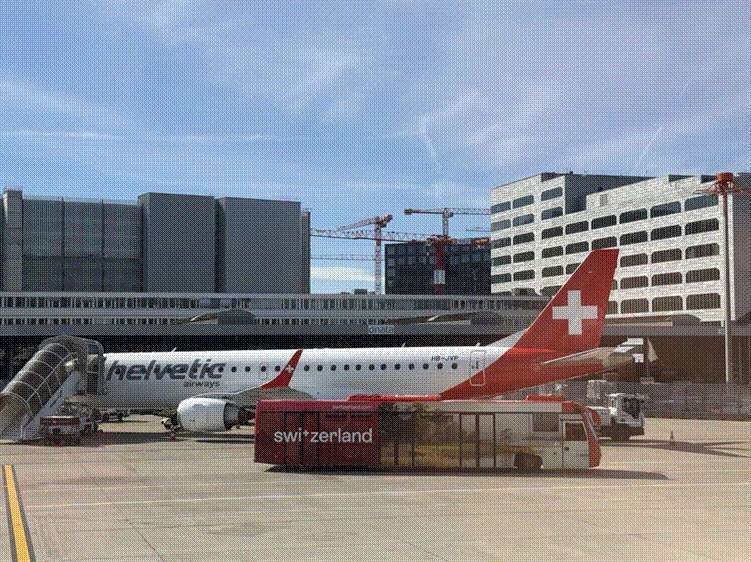
A Helvetic E190 at a remote stand with an apron bus. Not every passenger gets a jet bridge. Photo: Dimitris Zopounidis
The construction programme has a cost. In the first half of 2026, construction work restricted parts of the landside shopping centre. Commercial and parking revenue grew only 2%, more slowly than traffic.
Efficiency has softened in summer 2026. In July 2026, passengers grew 2.4% while movements grew 4.3%. Passengers per movement fell 2.5% and load factor fell 1.4 points to 82.9%. August followed the same pattern: passengers +1.8%, movements +2.9%, load factor 83.4% (−1.4 points). Capacity is currently growing slightly faster than demand. This is not a crisis, but it reverses the trend that made 2025 so efficient.
Revenue pressure is coming. From 1 October 2026, a new ordinance on airport charges takes effect. Charges will be about 10% lower overall, with higher noise charges and reclassified noise categories. The airport expects aviation revenue to remain stable in 2026 thanks to passenger growth. However, the cut will affect the last quarter of 2026 and the full year in 2027.
Concentration is a strength and a risk. With two thirds of passengers and almost all transfer traffic in the hands of a single airline group, Zurich’s hub function depends on decisions taken at Lufthansa Group level. The transfer segment’s stagnation in 2025 shows that the local market currently drives growth, not the hub.
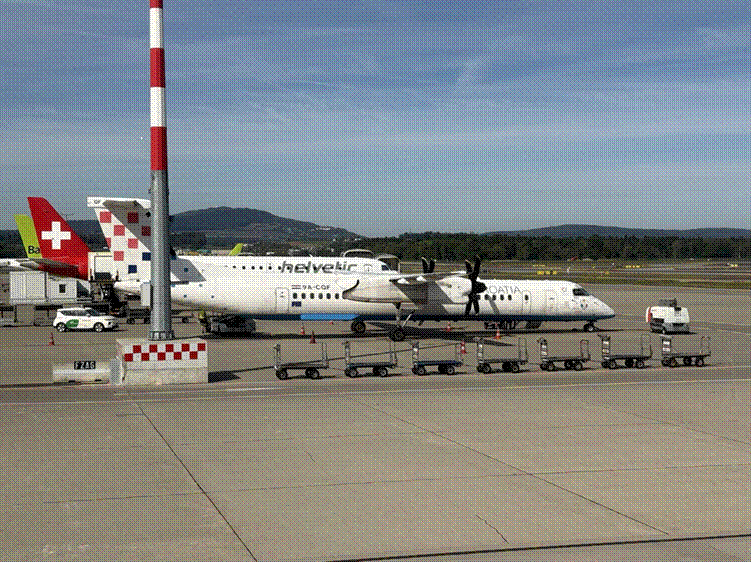
A Croatia Airlines Q400 at a remote stand, with baggage carts lined up. Photo: Dimitris Zopounidis
Final assessment
The question at the start was why Zurich feels so coherent. The answer is not one terminal, one airline or one architectural gesture.
It is the alignment of systems that are usually designed separately. A hub carrier whose network logic matches the airport’s physical layout. A railway station inside the terminal complex, connected to a national timetable. A design language that prefers restraint to display. And a regulatory environment that forces discipline: limited hours, fixed runways and constant public scrutiny. Under these constraints, the airport has learned to grow by carrying more people per movement rather than adding flights.

Lake Zurich shortly after take-off. The airport sits at the centre of a dense, connected country. Photo: Dimitris Zopounidis
Zurich’s elegance is functional rather than decorative. It does not come from what has been added, but from how well the parts fit together. The cranes on the skyline suggest that the airport knows this coherence cannot be taken for granted. It has to be rebuilt, one dock and one runway at a time, while the system keeps running.

Glaciers in the Alps on the climb-out south. Photo: Dimitris Zopounidis
The lesson from Zurich is not to copy its infrastructure. It is to copy its coherence.
Sources
Flughafen Zürich AG, “Zurich Airport reaches a new annual peak in passenger figures”, 14 Jan 2026. https://newsroom.flughafen-zuerich.ch/en/zurich-airport-reaches-a-new-annual-peak-in-passenger-figures/
Flughafen Zürich AG, Annual Report 2025, “Traffic volumes Zurich”. https://report.flughafen-zuerich.ch/2025/ar/en/traffic-volumes-zurich-site
Flughafen Zürich AG, Annual Report 2025, “Climate and energy”. https://report.flughafen-zuerich.ch/2025/ar/en/climate-and-energy
Flughafen Zürich AG, “Zurich Airport Ltd. generates higher profit in the first half of 2026”, 28 Aug 2026. https://newsroom.flughafen-zuerich.ch/en/zurich-airport-ltd-generates-higher-profit-in-the-first-half-of-2026/
Flughafen Zürich AG, “Key traffic figures August 2026”, 10 Sep 2026. https://newsroom.flughafen-zuerich.ch/en/key-traffic-figures-august-2026/
Flughafen Zürich AG, “Key traffic figures July 2026”, Aug 2026. https://newsroom.flughafen-zuerich.ch/en/key-traffic-figures-july-2026/
Flughafen Zürich AG, Annual Report 2019, “Trend in traffic volume”. https://report.flughafen-zuerich.ch/2019/ar/en/trend-in-traffic-volume/
Flughafen Zürich AG, Annual Report 2018, “Trend in traffic volume”. https://report.flughafen-zuerich.ch/2018/ar/en/trend-in-traffic-volume/
Flughafen Zürich AG, Annual Report 2021, “Traffic volumes Zurich”. https://report.flughafen-zuerich.ch/2021/ar/en/traffic-volumes-zurich/
Flughafen Zürich AG, Annual Report 2023, “Traffic volumes Zurich”. https://report.flughafen-zuerich.ch/2023/ar/en/verkehrskennzahlen-standort-zuerich
Flughafen Zürich AG, “22.6 million passengers at Zurich Airport”. https://www.flughafen-zuerich.ch/newsroom/en/226-million-passengers-at-zurich-airport/
Flughafen Zürich AG, “Zurich Airport: passenger figures almost reach pre-crisis level”, Jan 2025. https://newsroom.flughafen-zuerich.ch/en/zurich-airport-passenger-figures-almost-reach-pre-crisis-level/
Flughafen Zürich AG, “Modal split continues to develop positively”. https://newsroom.flughafen-zuerich.ch/en/modal-split-continues-to-develop-positively/
Flughafen Zürich AG, “Flight operations: operating hours, concepts and routes”. https://www.flughafen-zuerich.ch/en/company/responsibility/noise-and-sound-insulation/flight-operations
Flughafen Zürich AG, “Noise Monitoring FAQ”. https://www.flughafen-zuerich.ch/en/company/responsibility/noise-and-sound-insulation/noise-monitoring/noise-monitoring-faq
Flughafen Zürich AG, “Extensions to runways 28 and 32”. https://www.flughafen-zuerich.ch/en/company/flughafen-zuerich/airport-development/current-construction-projects/extensions-to-runways-28-and-32
Flughafen Zürich AG, “Extraordinary flight operations on 1 August 2025”. https://newsroom.flughafen-zuerich.ch/en/extraordinary-flight-operations-on-1-august-2025/
International Airport Review, “Zurich Airport records strong 2025 results as passenger numbers reach 32.6 million”, Mar 2026. https://www.internationalairportreview.com/zurich-airport-records-strong-2025-results-as-passenger-numbers-reach-326-million/1672479.article
International Airport Review, “Zurich Airport’s comprehensive approach to sustainability”, Mar 2026. https://www.internationalairportreview.com/article/185645/zurich-airports-comprehensive-approach-to-sustainability/
FlightGlobal, “Consultation opens on extension of Zurich runways to enhance safety”, 28 May 2026. https://www.flightglobal.com/archive/2026/05/consultation-opens-on-extension-of-zurich-runways-to-enhance-safety/
Airport Suppliers, “Runway extensions: requests for planning permission will be available for public review”, May 2026. https://www.airport-suppliers.com/airport_press_release/runway-extensions-requests-for-planning-permission-will-be-available-for-public-review/
SWI swissinfo.ch, “Zurich Airport to start runway extensions earliest in 2030”, Mar 2024. https://www.swissinfo.ch/eng/archive-workplace-switzerland/zurich-airport-to-start-runway-extensions-earliest-in-2030/73492033
Wikipedia, “Zurich Airport railway station” (citing the ZVV timetable). https://en.wikipedia.org/wiki/Zurich_Airport_railway_station
Wikipedia, “Zürich Oerlikon railway station” (IC 1 routing). https://en.wikipedia.org/wiki/Z%C3%BCrich_Oerlikon_railway_station
Flughafen Wien AG, “Vienna Airport sets new passenger records in 2025”. https://viennaairport.com/jart/prj3/news_press/uploads/db-con_def-uploads/va-news/E-02_2026.pdf
Flughafen Wien AG, Company profile. https://viennaairport.com/en/company/investor_relations/company
Copenhagen Airport, “Record year for Copenhagen Airport”, Jan 2026. https://www.cph.dk/en/about-cph/press/news/2026/01/record%20year%20for%20copenhagen%20airport
Wikipedia, “Vienna International Airport” (distance to city). https://en.wikipedia.org/wiki/Vienna_International_Airport
All photographs: Dimitris Zopounidis, Zurich Airport, September 2026.